DSA and coding
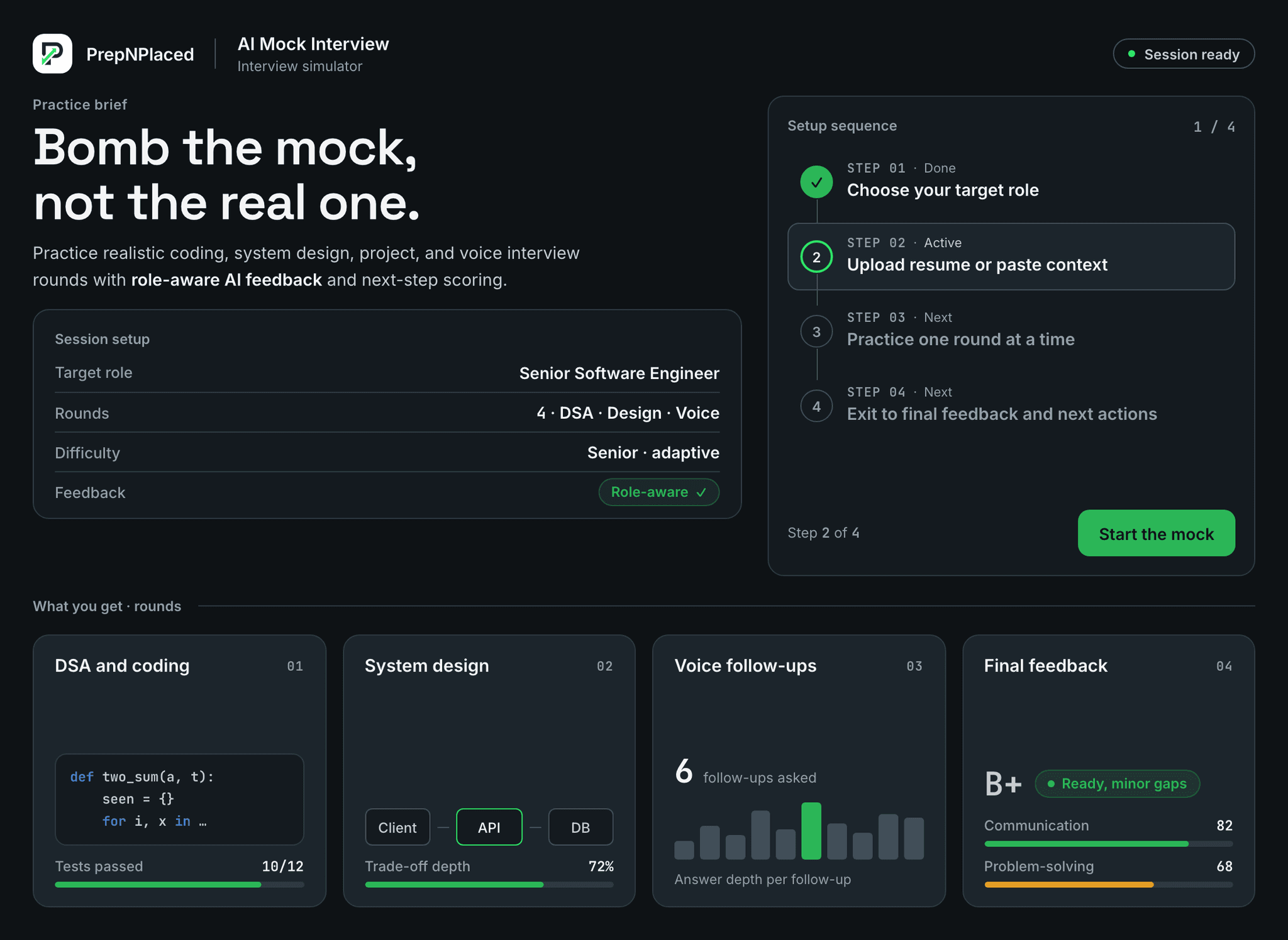
Solve coding prompts with boilerplate, test cases, doubts, and AI code review.
Practice realistic technical interview rounds with voice follow-ups, coding tests, system design whiteboard, project depth, and final feedback.
Why you can trust it
Everything below is what the tool actually does — with clear limits, guardrails, and the next step always visible.
Solve coding prompts with boilerplate, test cases, doubts, and AI code review.
Practice APIs, services, data models, scaling, tradeoffs, and architecture reasoning.
Answer natural follow-up questions and improve clarity, confidence, and structure.
Get round-wise score, weak areas, best-response guidance, and next preparation actions.
How it works
Each step below is what actually happens, in order — so you always know what comes next.
Choose your target role
Upload resume or paste context
Practice one round at a time
Exit to final feedback and next actions
Deep dive
A closer look at what this workspace does — and how each part helps you move faster.
The interview workspace covers coding, system design, project depth, behavioral, and role-specific technical rounds.
After the interview, the report focuses on score, gaps, best-response feedback, and next preparation actions.
A coding mock can ask the candidate to solve a function, run tests, explain edge cases, and defend time and space complexity.
A design mock can ask for APIs, entities, storage choices, scaling constraints, and reliability tradeoffs for a realistic product workflow.
Project deep-dive rounds check whether resume claims are defendable. The strongest answers explain ownership, tradeoffs, debugging, and business impact.
Many strong candidates lose signal because answers are unstructured. Voice practice helps candidates speak in a clear order: clarify the problem, state the approach, explain tradeoffs, then summarize the result.
A useful mock score should be explainable. Candidates need to know whether the issue was correctness, reasoning, complexity, edge cases, project depth, or communication, because each gap requires a different fix.
Before starting a full mock, candidates should pick a target role, score the resume against a JD, mark risky projects, and decide which round is most likely next. That makes the mock realistic instead of random.
For data roles, mock practice should cover SQL reasoning, metric definitions, dashboard tradeoffs, pipeline reliability, and project explanation. That prevents data candidates from practicing only generic DSA questions when the role needs applied analytics proof.
A good mock should produce a short improvement loop: fix the weakest answer, revise the related resume bullet if needed, practice one harder follow-up, and update your study plan before the next attempt.
The strongest mock interviews reuse the candidate's resume claims and target JD. That makes project questions, coding prompts, and system design follow-ups feel closer to the actual interview instead of generic practice.
Questions
Straight answers to the questions people ask most before getting started.
Yes. Coding rounds include prompts, boilerplate, tests, doubts, and AI review.
Yes. The workspace supports system design practice with architecture context and review.
Yes. The flow is designed to generate final feedback from the work completed so far.
Yes. Free includes 2 mock interviews to try it. Job Seeker gives 8 a month, and Pro Auto-Pilot is unlimited.
Coding and DSA rounds with a compiler, system design on a whiteboard, project deep-dives, and behavioral rounds — with voice-based practice so you rehearse speaking your answers, not just typing them.
Questions adapt to your target role and resume, arrive one at a time like a real interview, and the feedback is scored against a rubric covering correctness, communication, edge cases, and design reasoning.
Practice the actual rounds you'll face, review the rubric feedback after each mock, close your weakest gaps, and repeat until you can explain your reasoning out loud calmly.
Next workflow
Keep moving through the connected workflow without losing the target role context.
DSA Mock Interview
Practice coding prompts with tests and complexity review.
System Design Mock Interview
Practice APIs, data, scale, and tradeoffs.
Project Interview Practice
Prepare resume project deep dives.
Tech Interview Preparation India
Connect resume, DSA, system design, and project prep.
Rewrite My Resume
Prepare a better role-aligned resume.
See plans and pricing
The free tier needs no card. Paid plans are one payment for 1, 3 or 6 months, and nothing renews.
DSA and coding
System design
Voice follow-ups
Final feedback