Live job sources
Searches configured live sources and public role feeds where available.
Search live job sources, upload your resume, and rank jobs by role fit, location, freshness, source quality, and resume-match signals.
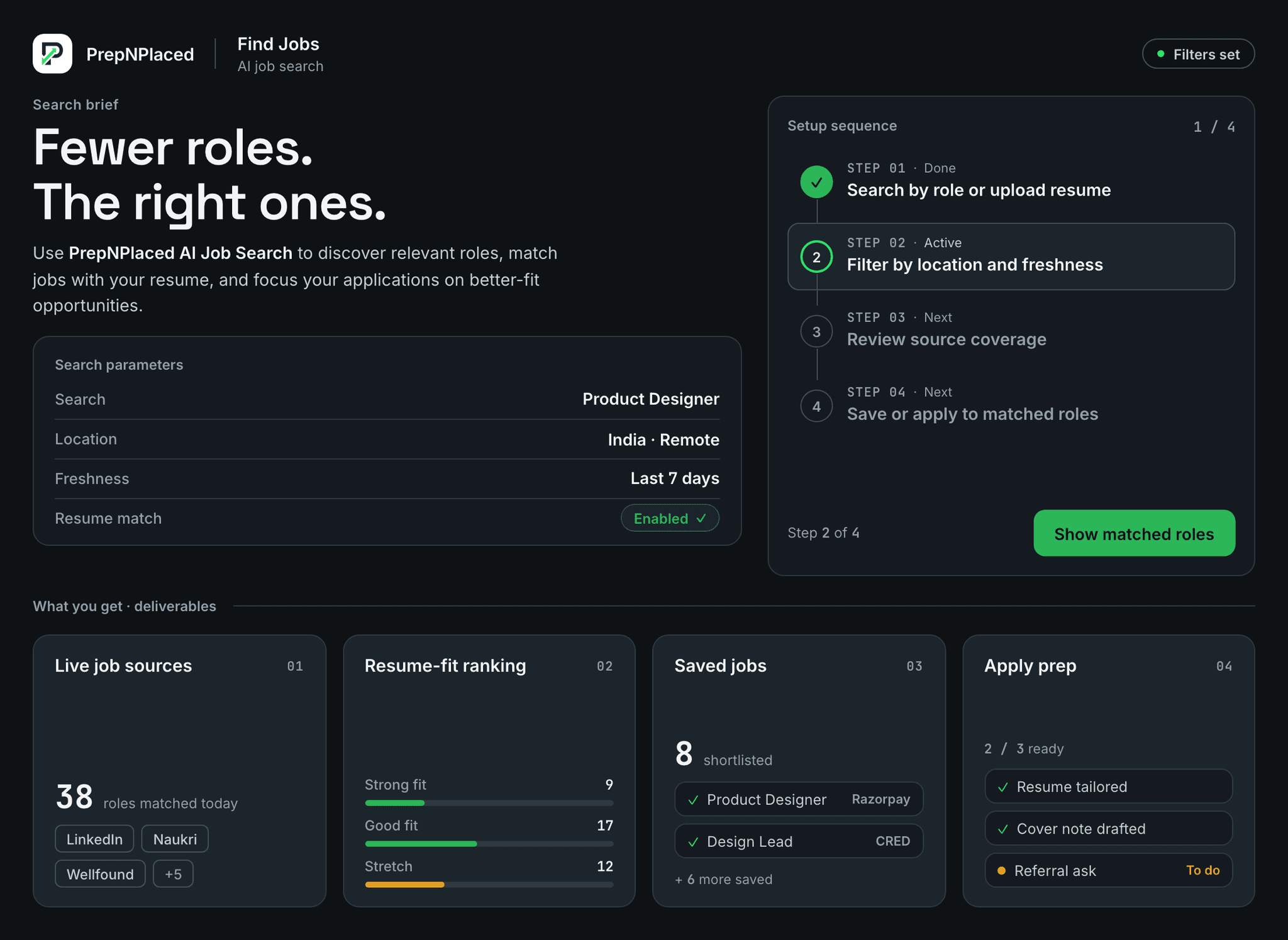
PrepNPlaced's Find Jobs searches live job sources for tech, data and fresher roles in India, then ranks every opening against your uploaded resume: role fit, skills overlap, location, how fresh the posting is and source quality. Save the matches worth tailoring for, check resume fit before you apply, and hand the rest to Auto Apply. Searching and matching are free.
Why you can trust it
Everything below is what the tool actually does — with clear limits, guardrails, and the next step always visible.
Searches configured live sources and public role feeds where available.
Ranks jobs by role fit, skills, location, freshness, and apply readiness.
Keeps promising jobs organized for resume tailoring and interview preparation.
Helps decide whether to apply now, tailor the resume, or prepare first.
How it works
Each step below is what actually happens, in order — so you always know what comes next.
Search by role or upload resume
Filter by location and freshness
Review source coverage
Save or apply to matched roles
Deep dive
A closer look at what this workspace does — and how each part helps you move faster.
The job search layer combines API providers, public job sources, ATS listings, and deterministic HTML extraction where available.
Resume-matched search compares the listing against your role, skills, experience, location, and freshness.
A fit score should help decide where to spend effort. It looks at title match, skill overlap, location, freshness, source confidence, and whether the resume has proof for the role.
Every serious job description should feed Resume Score, a Rewrite My Resume pass, your Company Game Plan, and mock interview prompts before the final application.
PrepNPlaced job search is designed to support responsible applications. This candidate workflow keeps user control at the center: candidates remain responsible for reviewing roles, answers, and final submissions.
The ranking should compare role title, required skills, seniority, freshness, location, source confidence, and resume proof. It does not need to expose private scoring weights to explain why a role deserves attention.
High-fit roles deserve a tailored resume and mock interview practice. Stretch roles may need a study plan before applying. Low-fit roles should usually be skipped unless there is a clear reason to invest time.
The strongest workflow is human-controlled: find roles, compare fit, improve the resume, practice likely gaps, and apply after reviewing the company, role, location, and recruiter questions.
A job workflow should never guess sensitive or profile-changing answers. If a listing asks for relocation, expected CTC, notice period, eligibility, or custom screening answers, the candidate should review the question before submission.
The best job search pages do more than list openings. Each saved JD should create a resume check, a Company Game Plan, and a mock interview topic list so the candidate improves even before the interview invite arrives.
Questions
Straight answers to the questions people ask most before getting started.
The platform can use configured sources such as Adzuna, Jooble, JobSpy, Remotive, ATS sources, and deterministic HTML sources.
Yes. Resume-matched search ranks roles against your skills, experience, target role, and location.
Find Jobs discovers and ranks roles. The supervised Naukri Auto Apply workspace handles the Naukri application flow separately.
Upload your resume and use resume-matched search — it extracts your skills and experience and ranks live openings by how closely they fit you, showing matched skills and gaps for each role.
Type the company name and leave the role blank to see every open role there, or add a role to narrow it down. Cards also flag people you can reach for a referral.
Instead of a keyword list, results are ranked by fit to your actual resume, duplicate postings are removed, and each job shows applicant counts and insider referral cues — so you apply to fewer, better-matched roles.
Yes — you get free searches every day, with unlimited Find Jobs on any paid plan.
Next workflow
Keep moving through the connected workflow without losing the target role context.
Find Referrals
Find a real person at the target company and get a warm intro.
Jobs Matched to Your Resume
Rank jobs by role fit and apply readiness.
Rewrite My Resume
Tailor resume before applying.
Resume Score
Check JD fit and proof gaps before applying.
AI Mock Interview
Practice likely questions from a target JD.
Naukri Auto Apply
Use the supervised application workspace.
See plans and pricing
The free tier needs no card. Paid plans are one payment for 1, 3 or 6 months, and nothing renews.
Live job sources
Resume-fit ranking
Saved jobs
Apply prep