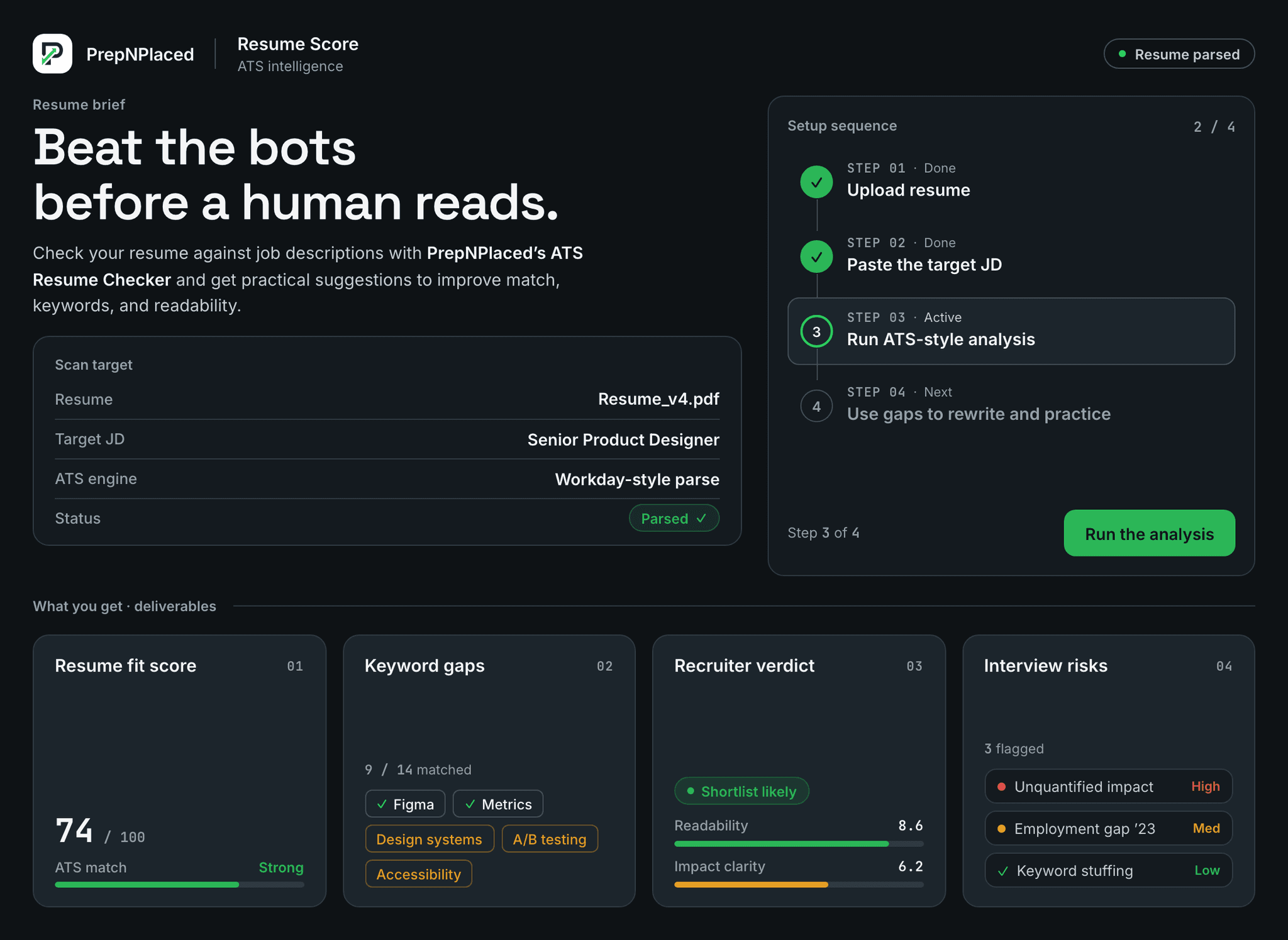
Resume fit score
Compares your resume with a target job description and shows how closely it fits.
Score your resume against a real job description and see recruiter-style gaps across skills, keywords, experience relevance, and evidence strength.
Paste your resume and pick your target role. You get the keyword coverage an ATS actually measures, instantly and free.
Why you can trust it
Everything below is what the tool actually does — with clear limits, guardrails, and the next step always visible.
Compares your resume with a target job description and shows how closely it fits.
Finds important skills, tools, and role terms that are missing or underused.
Explains whether your resume looks strong, borderline, or weak for the target role.
Highlights proof gaps that may become follow-up questions in interviews.
How it works
Each step below is what actually happens, in order — so you always know what comes next.
Upload resume
Paste the target JD
Run ATS-style analysis
Use gaps to rewrite and practice
Deep dive
A closer look at what this workspace does — and how each part helps you move faster.
ATS stands for Applicant Tracking System: the software a company uses to collect applications, store resumes and let recruiters search them by keyword. Naukri's recruiter search, Workday, Greenhouse, Lever, SAP SuccessFactors and Taleo are all ATSs. A recruiter types "Power BI" and "SQL", the ATS returns the resumes containing those words, and a resume without them is never opened.
The free check on this page reads the resume you paste, matches it against the keyword list for the role you pick, and reports coverage: how many of that role's keywords appear in your text, as a percentage, with the missing ones listed. It runs in memory and nothing is stored. The full report inside a free account adds what keyword matching cannot see: whether each keyword is backed by real work, how the resume reads to a recruiter, and which claims an interviewer will probe.
Instead of generic resume feedback, Resume Score reads the job description and compares your resume against that role.
The report explains what is strong, what is missing, and what may come up in interviews.
The checker looks for role-fit signals that recruiters and screening systems commonly care about before shortlisting.
A keyword gap is when the job description names skills your resume never shows. If a data analyst JD asks for SQL window functions, Power BI, and stakeholder dashboards, a resume that only says 'data analysis' has a keyword gap and a proof gap.
Treat the score as preparation guidance, not a guarantee. Strong-fit resumes still need interview proof, and low scores should turn into rewrite and practice tasks.
A useful score should separate skill coverage, proof quality, section quality, role seniority, recruiter readability, and interview risk. That prevents candidates from chasing one magic number while ignoring whether the resume can survive follow-up questions.
A proof gap is a skill the resume claims but never backs with evidence. A backend JD may ask for APIs, databases, and performance work, and a resume that says 'built backend features' has weak proof until it names the API, database, scale, bug, test, or user impact the candidate can explain.
A recruiter-readable resume makes the target role, strongest skills, recent proof, and measurable work easy to scan. It avoids dense paragraphs, unsupported claims, and tool lists that are disconnected from projects.
Keyword stuffing can make a resume look matched while making the interview harder. If a skill appears on the resume, the candidate should be ready to explain when it was used, why it mattered, and what tradeoff came with it.
A strong-fit score should trigger interview rehearsal, not complacency. A moderate-fit score should trigger targeted rewrites. A weak-fit score should trigger role-fit review, project work, or a smaller target role before sending applications.
Questions
Straight answers to the questions people ask most before getting started.
ATS is short for Applicant Tracking System, the software employers use to collect applications and search resumes by keyword. The free score on this page measures how many of a role's keywords your resume contains, which is what that search finds first.
No. It is job-description based, so the score is tied to the target role rather than generic resume rules.
Yes. It highlights missing keywords, weak proof, and role-specific resume gaps.
Use Rewrite My Resume to rewrite your resume and AI Mock Interview to practice the gaps that may be challenged.
It compares your resume against the target job description — matching required keywords and skills, checking proof strength, and flagging formatting that a real applicant tracking system might misread — then returns a fit score with the exact gaps.
As a rough guide, 80+ is strong, 60–80 is workable with fixes, and below 60 means important keywords or proof are missing. Focus on closing the must-have gaps rather than chasing a perfect number.
Usually because they miss the job's key skills and keywords, bury results in dense text, or use layouts (tables, columns, graphics) the parser can't read. The checker points to each of these so you can fix them.
Yes — you get free scans to check your fit, and unlimited ATS scoring plus the resume rewrite tools on any paid plan.
Next workflow
Keep moving through the connected workflow without losing the target role context.
Find Referrals
Find a real person at the company and get a warm intro.
Rewrite My Resume
Rewrite after scoring.
Data Analyst Resume Builder
Improve analyst resume proof with SQL, dashboards, and metrics.
Jobs Matched to Your Resume
Use fit signals to prioritize relevant jobs.
Find Jobs
Find roles and turn each JD into resume actions.
PrepNPlaced Platform
Use the full preparation system.
See plans and pricing
The free tier needs no card. Paid plans are one payment for 1, 3 or 6 months, and nothing renews.
Resume fit score
Keyword gaps
Recruiter verdict
Interview risks