India score benchmarks
The match levels that typically clear screening at services companies versus product companies and GCCs.
How resume screening actually works in Indian hiring — services giants, GCCs, product companies and Naukri — with the score benchmarks that matter and a free checker built for Indian resumes.
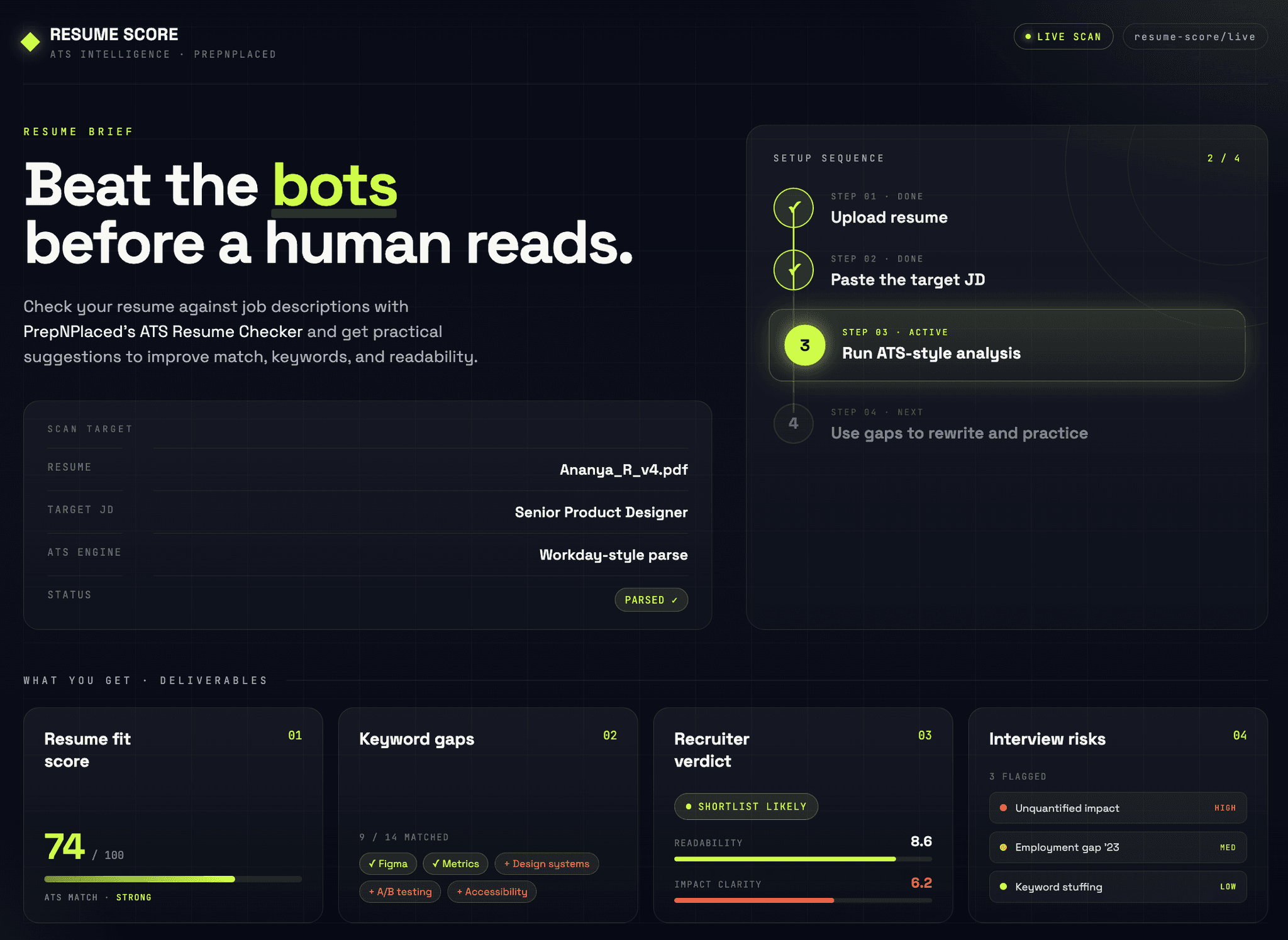
Why you can trust it
Everything below is what the tool actually does — with clear limits, guardrails, and the next step always visible.
The match levels that typically clear screening at services companies versus product companies and GCCs.
TCS, Infosys and Wipro screen differently from Flipkart or a GCC — volume filters versus role-fit depth.
Your Naukri profile score and an employer's ATS score are different systems — what each one actually reads.
India-specific resume conventions — CTC expectations, notice period, education-first layouts — and what screeners skip.
How it works
Each step below is what actually happens, in order — so you always know what comes next.
Upload your resume (3 free checks)
Paste the exact JD you are applying to
Read your India-benchmarked score and gaps
Fix honestly, re-check, then apply
Deep dive
A closer look at what this workspace does — and how each part helps you move faster.
Indian hiring runs on three different screening realities. Mass recruiters (TCS, Infosys, Wipro, Cognizant, Accenture) filter enormous applicant pools on skill keywords, education fields and experience bands before a human reads anything. GCCs and product companies use role-fit screening — fewer applicants, deeper JD matching. And Naukri itself ranks your profile for recruiter search, which is a separate system from any employer's ATS.
As a working benchmark used across Indian hiring communities: around 75% match is generally competitive for IT-services applications, while product companies and GCCs reward 80%+ with strong evidence behind each keyword. Treat these as directional bands, not magic numbers — a defensible 78% beats a stuffed 90% the moment an interviewer starts asking questions.
Naukri's profile completeness and search ranking decide whether recruiters FIND you on Naukri. An employer's ATS score decides whether your APPLICATION clears their screening. Optimising one does not optimise the other: a 100% complete Naukri profile can still carry a resume that fails a JD match, and a strong resume can sit invisible on an incomplete profile. Work on both, separately.
US-built resume checkers don't know Indian conventions. This one reads Indian resumes as Indian recruiters do: CTC and notice-period lines are normal (not clutter), education often leads for freshers, and institute names carry weight. It also flags what Indian screeners skip past — long objective paragraphs, photos, and declaration footers that spend space without adding signal.
Questions
Straight answers to the questions people ask most before getting started.
As a directional band: around 75% JD match is competitive for IT-services companies, and 80%+ with real evidence behind each keyword is the level product companies and GCCs reward. Scores above that add little unless every claim survives interview questioning — defensibility matters more than the last five percent.
Large Indian services recruiters screen at massive scale using keyword, eligibility and experience-band filters across their application systems before human review. The practical effect for you is identical to a strict ATS: if the JD's named skills aren't clearly present in your resume, a person may never see it.
No. Naukri's score measures profile completeness and search visibility to recruiters on Naukri. An ATS score measures how well your resume matches a specific job description in an employer's screening system. They are different systems reading different documents — improve both, but don't confuse them.
Yes — you get 3 free scores with no card, and the checker is built for Indian hiring: it understands CTC and notice-period conventions, fresher education-first layouts, and scores your resume against the exact JD you paste, the way Indian screening actually evaluates applications.
No — the JD-match model means one generic resume under-scores everywhere. Keep one honest master resume, then tailor keywords and project emphasis per application. PrepNPlaced's Rewrite My Resume does this without inventing anything: every claim stays traceable to your real experience.
Next workflow
Keep moving through the connected workflow without losing the target role context.
Free ATS Resume Checker
The checker itself — how scoring, keyword gaps, and recruiter verdicts work.
Rewrite My Resume
Tailor your resume to each JD honestly — every claim stays traceable to real experience.
Naukri Auto Apply
Once the resume scores well, apply at volume with a supervised visible browser.
India score benchmarks
Services vs product screening
Naukri vs employer ATS
Fresher-resume checks