Azure Data Factory Interview Questions: Scenarios, Answers & Prep
Azure Data Factory questions dominate Azure data engineer rounds at Indian services firms and GCCs, and they almost always run alongside a scenario-SQL round. These 16 answers cover pipelines, integration runtimes, triggers, incremental loads, and CI/CD the way strong candidates actually explain them.
By Durgesh Yadav — Senior Data Engineer @ 7-Eleven · Updated 19 Oct 2026. Preparation guidance, not a hiring guarantee.
What should I prepare for an Azure Data Factory interview?
Master five areas: pipeline design with activities like Copy, Lookup, and ForEach; integration runtimes (Azure vs self-hosted); triggers (schedule, tumbling window, event); incremental loading with watermarks; and CI/CD with Git plus ARM templates. Indian interviews pair ADF scenarios with SQL, so practice metadata-driven frameworks and explain one production pipeline end to end.
Services majors (TCS, Infosys, LTIMindtree, Accenture) and GCCs rarely stop at definitions — after two warm-up questions the interviewer pivots to "how did you do this in your project". ADF rounds almost always run beside a scenario-SQL round, so the pipeline you describe should connect to the SQL you can write on the spot.
Definitions get five minutes; your project's pipeline design gets twenty-five
Expect a live design ask: incremental load, metadata-driven ingestion, or failure recovery
ADF + SQL is the standard combo — window functions and dedupe queries follow the ADF questions
Which ADF scenario patterns should you master?
Nearly every ADF scenario question is a variation of a handful of patterns. Prepare each as a two-minute whiteboard answer that names the exact activities in order — interviewers score specificity, not vocabulary.
Failure handling: activity retry policy, red failure paths to alerts, rerun from failed activity
What do ADF interviews ask candidates with 5+ years of experience?
At five years and above, ADF questions move from what an activity does to how you designed, deployed and repaired a platform. Expect to walk through a framework you built, how it reaches production, how you recover from a failed run without reloading everything, and what you did about cost and security, with numbers from your own project: tables, volumes and run times.
Design: a metadata-driven framework for hundreds of tables, with a control table, parameterized child pipelines and a watermark per table
Operations: rerunning from the failed activity, alerting, and keeping a late or bad file from reaching downstream tables
CI/CD: Git integration, ARM template deployment through a release pipeline, and stopping and restarting triggers around it
Security and cost: managed identity, Key Vault for secrets, the self-hosted runtime for on-premises sources, and how you cut Data Flow spend
Direction: what changes when the same pipelines move to Fabric Data Factory
What do ADF roles pay, and what pairs with ADF?
ADF alone is an orchestration skill; ADF plus Databricks/PySpark and a warehouse is a data engineering profile. GCCs and product companies pay more than services firms for that profile when it comes with strong pipeline-design depth. This page quotes no pay figures. PrepNPlaced's India Tech Hiring Report found that fewer than 300 of its postings disclosed an INR salary, too few to publish honestly.
Pair ADF with PySpark/Databricks and Synapse or Snowflake for the strongest profile
DP-203 has retired; DP-700 (Fabric Data Engineer) is the certification recruiters now screen for
Fabric Data Factory is the forward path — ADF concepts transfer almost one-to-one
What is the difference between a Copy activity, a Mapping Data Flow and a Databricks activity?
Three ways to move or shape data, three cost and skill profiles, and the interviewer wants to hear you pick by workload. Copy activity moves bytes between linked services with no transformation beyond column mapping and type conversion; it is the cheapest, and it runs on the integration runtime you choose, including the self-hosted one for on-premises sources. Mapping Data Flows are visual Spark jobs: joins, derived columns, aggregates and slowly changing dimensions without writing code, billed by the cluster time they consume, with a warm-up that makes them a poor fit for small, frequent loads. A Databricks notebook activity hands the work to your own cluster and code: the most flexible, the most expensive to operate, and the right answer when the logic already lives in PySpark.
Copy activity: movement and mapping only; self-hosted IR for on-premises sources; cheapest per run
Mapping Data Flow: no-code Spark; pays cluster time plus warm-up; use it for joins, SCDs and aggregates on medium batches
Databricks activity: your notebook, your cluster; pick it when the transformation is already PySpark or needs libraries
Interview tell: the candidate who reaches for a Data Flow to copy a table has not paid for one yet
Worked scenario: incremental load with a watermark
A Lookup activity reads the last watermark from a control table; a second Lookup reads MAX(modified_at) from the source; the Copy activity runs SELECT * FROM orders WHERE modified_at > '@{activity('OldWatermark').output.firstRow.value}' AND modified_at <= '@{activity('NewWatermark').output.firstRow.value}'; a Stored Procedure activity writes the new watermark only after the copy succeeds. The trap: updating the watermark before the copy, which silently drops rows on the first failure.
Schedule trigger vs tumbling window trigger
A schedule trigger fires at a time and forgets. A tumbling window trigger owns a fixed, non-overlapping interval, retries it, and can be re-run window by window. If the pipeline uses the window start and end as query bounds, the tumbling window is the right answer; if it only runs 'now', a schedule trigger is enough.
Depends on cluster networking; usually staged first
Pick it when
The job only moves bytes, like watermark loads
A low-code team needs joins or SCDs on batches
The logic already exists as PySpark or needs libraries
For the cloud round
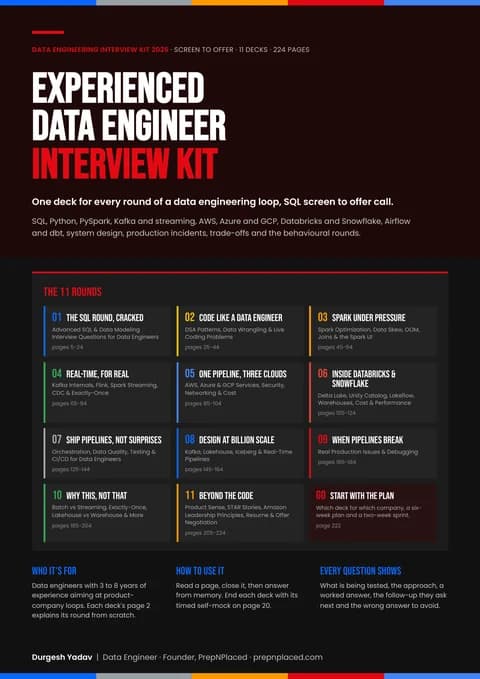
Experienced Data Engineering Interview Kit 2026
Deck 05, One Pipeline, Three Clouds, covers the aws, azure and gcp round. Learn one cloud deeply and map the other two. The service map across AWS, Azure and Google Cloud, the questions each stack is known for, the security, networking and cost problems that break real jobs, and migrations.
Real questions from beginner to advanced, each with a concise model answer — practice them, then rehearse live in a mock interview. Every answer is open; collapse any you have already covered.
EasyWhat is Azure Data Factory and where does it fit in a data platform?
ADF is Azure's managed, serverless data integration and orchestration service: you compose pipelines of activities that move and transform data without provisioning infrastructure, paying per activity run. It covers ingestion (Copy activity with 100+ connectors), orchestration (triggers, dependencies, retries, alerting), and transformation — visually with Mapping Data Flows, which compile to Spark, or by delegating to Databricks, Synapse, or stored procedures. In a typical Azure stack it is the orchestration layer over a lake and warehouse, and the framing interviewers look for is ELT coordinator rather than compute engine: ADF only executes transforms itself when Data Flows run; everything else it dispatches. The same engine also surfaces as Synapse pipelines and Fabric Data Factory.
EasyWhat is the difference between a linked service and a dataset?
A linked service is the connection definition: endpoint plus authentication — connection string, service principal, managed identity, or a Key Vault secret reference. A dataset is a named pointer to specific data inside that connection: a table, folder, or file path together with format settings such as Parquet, CSV, or JSON. Activities consume datasets, and every dataset binds to exactly one linked service. The follow-up interviewers probe: both are parameterizable, so one parameterized linked service and one generic dataset can serve hundreds of tables — the foundation of metadata-driven frameworks. Keep the boundary straight: auth and integration-runtime binding live on the linked service, format and schema live on the dataset — mixing those up is the classic slip.
EasyWhat are the three types of integration runtime in ADF?
Azure IR is fully managed compute for cloud-to-cloud copies and Mapping Data Flows; it can auto-resolve its region or be pinned, and the managed VNet flavour adds private endpoints. Self-hosted IR is an agent you install on a VM or on-prem machine to reach private networks, firewalled sources, or systems needing local drivers such as Oracle or SAP — it makes outbound-only 443 calls, so no inbound firewall holes. Azure-SSIS IR is a managed cluster that lifts and shifts existing SSIS packages with SSISDB. The IR is where data movement actually executes, so name the nuances: Data Flows run only on Azure IR, never self-hosted, and for external compute like Databricks the IR merely dispatches the call — the heavy lifting happens on the other side.
EasyWhat trigger types does ADF support?
Four types. Schedule triggers fire on wall-clock cadence, are many-to-many with pipelines, and keep no state — an occurrence missed while the trigger is stopped is simply skipped. Tumbling window triggers run fixed-size, non-overlapping windows with state: per-window retry, backfill of past windows, self-dependency (window N waits for N-1), dependencies on other tumbling triggers, and they pass trigger().outputs.windowStartTime/EndTime into the pipeline. Storage event triggers fire on blob created/deleted via Event Grid — the trap being that the Event Grid resource provider must be registered on the subscription. Custom event triggers listen to your own Event Grid topics. Tumbling window is the only type with catch-up, which is why it anchors incremental slice loads.
EasyWhat is the Copy activity and what does it need to run?
Copy activity moves data from a source dataset to a sink dataset over an integration runtime that must have network reach to both ends, with optional column mapping, format conversion, and compression. On Azure IR it scales via Data Integration Units (up to 256) and parallelCopies; on self-hosted IR, DIUs don't apply — node CPU, memory, and the concurrent-jobs limit govern throughput, a distinction interviewers probe. It also offers fault tolerance (skip and log incompatible rows instead of failing) and staged copy through Blob storage. Binary copy is the fast path when no parsing is needed, but it forbids mapping and format change. The monitoring blade breaks each run into queue, read, and write time — always your starting point for tuning.
MediumWhen do you need a self-hosted IR, and how do you make it highly available?
Use self-hosted IR when the source is on-prem, inside a private VNet you cannot reach with managed private endpoints, behind a firewall, or needing a local driver such as Oracle or SAP. For HA, register up to four nodes against the same IR key: they share encrypted credentials, load-balance jobs, and you cap concurrent jobs per node. One node is a single point of failure — jobs queue until it returns — so two nodes is the practical minimum for production. The agent makes outbound-only 443 connections, so no inbound firewall rules are needed. Two traps worth naming: never install it on the source database server, because copies will steal CPU from the workload you are reading, and it cannot execute Mapping Data Flows — those only run on Azure IR.
MediumScenario: load only new and changed rows from an on-prem SQL Server table daily. How?
Classic watermark pattern. A watermark table stores the last loaded value of a monotonically increasing column such as ModifiedDate. The pipeline: Lookup the stored watermark, Lookup the current MAX(ModifiedDate) from the source, Copy with WHERE ModifiedDate > old AND <= new, then a Stored Procedure activity updates the watermark only after the copy succeeds, so failed runs rerun safely. Capture MAX up front rather than filtering on GETDATE() — otherwise rows written mid-run fall into a gap. Make the load idempotent (MERGE or delete-then-insert on the key range) so a retry cannot duplicate. Pre-empt two probes: watermarks never see deletes — you need CDC, Change Tracking, or soft-delete flags for those — and the watermark column must be indexed and trustworthy, or the pattern falls over.
MediumTumbling window trigger vs schedule trigger — when does the choice actually matter?
Tumbling window is one-to-one with a pipeline and stateful: per-window retry, backfill of historical windows, self-dependency so window N waits for N-1, dependencies on other tumbling triggers, a concurrency cap, and trigger().outputs.windowStartTime/EndTime handed to the pipeline for slice boundaries. Schedule triggers are many-to-many, stateless, fire-and-forget — no retry, no backfill, and occurrences missed while the trigger is stopped are skipped, not queued; tumbling windows are queued and executed when possible. So the choice matters exactly when a missed interval must be reprocessed: hourly incremental slices belong on tumbling window, while a simple kick-off-the-nightly-batch-at-02:00 is fine on schedule. Treating them as interchangeable clocks gets marked down.
MediumHow do you parameterize ADF so you don't build one pipeline per table?
Push everything through parameters: pipeline parameters, dataset parameters (schema, table, path), and parameterized linked services where the server itself varies, referenced with dynamic content such as @pipeline().parameters.tableName and @dataset().schemaName. A Lookup reads a control table, ForEach iterates it, and one generic Copy handles every table; global parameters carry environment values that CI/CD overrides per stage. Know the limits interviewers probe: Lookup returns at most 5,000 rows / 4 MB, so paginate a bigger control table; ForEach parallelism caps at 50 via batchCount; and ForEach cannot nest — the workaround is an Execute Pipeline child holding the inner loop. Parameters are immutable at runtime; use variables with Set Variable when a value must change mid-run.
MediumMapping Data Flows vs Copy activity vs calling Databricks — how do you choose?
Copy activity for pure movement — cheapest and fastest, nothing beyond mapping, format conversion, and compression. Mapping Data Flows for visual transforms (joins, aggregates, dedupe, SCD) on ADF-managed Spark: good for low-code teams, but budget the several-minute cluster spin-up per run unless you set a TTL on the integration runtime, and an idle debug session keeps billing until it expires. Databricks or Synapse notebooks when you need custom code, unit tests, Delta Lake features, streaming, or the logic already lives in a Spark estate — ADF then just orchestrates. The trade-off to state plainly: Data Flows compile to Spark anyway, so the real choice is who owns the logic — a drag-and-drop surface locked inside ADF, or versioned code your engineers can test and reuse outside it.
MediumYour Copy activity is slow. How do you tune it?
Start with the copy monitoring breakdown — it splits the run into queue, source read, and sink write time, so you tune the actual bottleneck instead of guessing. Then, in order: raise DIUs (up to 256, Azure IR only) and parallelCopies; enable source partitioning — physical partitions or a dynamic range over a numeric/date column; use staged copy with PolyBase or the COPY statement when loading Synapse; prefer binary passthrough when no format conversion is needed. File shape matters: thousands of tiny files destroy throughput, so compact or batch them. If a self-hosted IR is involved, check node CPU, memory, bandwidth, and the concurrent-jobs setting — DIUs do not apply there. The trap: paying for more DIUs when the breakdown shows the sink, say a single Azure SQL DB, is the ceiling.
MediumHow do you implement error handling and alerting in ADF pipelines?
Layer it. Activity-level retry with an interval absorbs transient failures. Dependency conditions (success, failure, completion, skipped) give you try-catch-finally shapes: wire the failure path to a Web or Logic App activity that posts to Teams or email with @activity('X').error.message. Now the classic trap: a pipeline's status comes from its leaf activities, so if the failure-handler itself succeeds, the run can report Succeeded — end the error branch with a Fail activity to re-raise with your own message and error code. Add Azure Monitor alerts on pipeline-run metrics and ship diagnostics to Log Analytics for coverage and history beyond ADF's 45-day retention. For recovery, rerun from the failed activity in the monitoring blade rather than replaying the whole pipeline.
HardDesign a metadata-driven framework to ingest 200+ tables with mixed full and incremental loads.
A control table in Azure SQL holds per-table metadata: source and sink identifiers, load type, watermark column and last value, active flag, and a batch group for ordering. An orchestrator Looks up active rows and a ForEach (batchCount for parallelism, capped at 50) invokes a parameterized child pipeline per row; the child branches full vs incremental (Switch or If), runs a generic Copy against parameterized datasets, updates the watermark only on success, and writes an audit row with counts, duration, and status. Respect the Lookup 5,000-row cap by paginating, and watch sink contention when many tables land in one database at once. The line interviewers want: onboarding table 201 is an INSERT, not a new pipeline — ADF's built-in metadata-driven copy task can scaffold this.
HardHow does CI/CD work for ADF, and what breaks most often?
Only the dev factory is Git-attached; feature branches merge to main by PR, and test/prod are deploy-only targets. Deployment is ARM-based: either the classic Publish button writing to adf_publish, or — better — the @microsoft/azure-data-factory-utilities npm package exporting ARM in a CI build, no manual publish. The release overrides ARM parameters per environment: linked service endpoints, Key Vault references, global parameters. What breaks most often: skipping the pre/post-deployment PowerShell script that stops triggers before deploying and restarts them after — active triggers can fail the deployment — and forgetting its cleanup flag, so resources deleted in dev live on in prod. Not every property is parameterized by default; a custom parameter definition file fixes that.
HardHow do you handle schema drift when sources add or rename columns?
In Mapping Data Flows, enable Allow schema drift on source and sink so unmapped columns flow through, replace fixed mappings with rule-based mapping or byName()/byPosition() expressions, and enable Infer drifted column types cautiously — it can guess wrong on sparse data. In Copy activity, avoid hard-coded mappings, or rebuild them dynamically from Get Metadata output. For strict contracts, do the opposite: validate the actual structure from Get Metadata against the expected schema and fail fast into the alert path with a Fail activity. Pre-empt two probes: a rename looks identical to a drop-plus-add, so no engine can infer intent — that needs a mapping layer or a source-team contract — and drifted columns are invisible at design time, so fixed downstream column references silently break.
HardScenario: an event trigger fires per file, files arrive in bursts of thousands, and the downstream MERGE deadlocks. Fix the design.
Decouple arrival from processing. Let the event trigger do the minimum — log the file into a control table or drop a queue message — then process on a tumbling-window pipeline that batches everything landed in the window: list the folder, one wildcard Copy, one MERGE per window instead of thousands. Setting pipeline concurrency to 1 also serializes runs, but it just queues the burst and latency balloons — batching is the scalable fix. Two mark-earning nuances: Event Grid delivery is at-least-once, so the same blob can fire twice — dedupe on filename in the log table for idempotency — and thousands of per-file runs also burn activity-run cost and factory limits, not just the sink. Name the root cause: per-file triggering plus a non-serialized sink was the flaw, not the MERGE itself.
By company
Data Engineer interviews that ask these questions
See how this topic shows up in real Data Engineer loops — rounds, difficulty and company-specific questions:
Is ADF enough on its own to get a data engineer job in India?
Rarely. ADF handles orchestration and movement; interviewers expect a transformation skill beside it — PySpark/Databricks or strong warehouse SQL. The typical successful profile is ADF + SQL + Databricks, where ADF questions test design and the SQL round tests depth.
What are the most common ADF scenario-based interview questions?
Incremental load with watermarks, metadata-driven ingestion for many tables, Copy activity performance tuning, failure handling and reruns, and event-triggered file processing. Each maps to a named activity chain — practice saying Lookup, ForEach, Copy, Execute Pipeline, and Stored Procedure out loud in sequence.
ADF vs Synapse pipelines vs Fabric Data Factory — which should I learn?
They share the same engine, so linked services, integration runtimes, triggers, and parameterization all transfer. Microsoft's investment is moving to Fabric, so learn ADF fundamentals and skim Fabric's differences (connections instead of linked services, capacity-based compute). Interviewers accept experience in any of the three.
How much SQL should I prepare alongside ADF?
A lot — the ADF-plus-SQL combo round is standard in Indian interviews. Expect window functions (ROW_NUMBER for dedupe, LAG for change detection), joins on large tables, and writing the exact watermark query your pipeline would execute against the source.
Next Step
Turn The Guide Into Practice
Use PrepNPlaced tools to turn this learning path into resume proof, targeted practice, and interview-ready explanations.