Databricks Interview Questions and Answers for Data Engineers (2026)
Sixteen real Databricks questions from Indian data engineering interviews — Delta Lake internals, Unity Catalog, Auto Loader, DLT, and cost tuning, answered the way strong candidates answer them in services, GCC, and product-company rounds.
By Durgesh Yadav — Senior Data Engineer @ 7-Eleven · Updated 19 Oct 2026. Preparation guidance, not a hiring guarantee.
What are the most asked Databricks interview questions?
Databricks interviews in India centre on the lakehouse concept, Delta Lake internals (ACID via the transaction log, time travel, OPTIMIZE and Z-ORDER), medallion architecture, Auto Loader, Unity Catalog governance, and cluster versus job design. Senior rounds add Photon, Delta Live Tables, and cost questions like choosing job clusters and spot instances over all-purpose clusters.
Databricks is a managed data platform built by the creators of Apache Spark around the lakehouse idea: Spark compute, Delta Lake tables with ACID transactions and time travel, notebooks, scheduled jobs, SQL warehouses and Unity Catalog governance, run on AWS, Azure or Google Cloud. It replaces the cluster you would otherwise assemble yourself. Interviews ask how Delta Lake works, how you tune a job, and how the pieces fit.
Delta Lake is the storage layer: a transaction log over Parquet files gives ACID, time travel and MERGE
Compute is Spark; the notebook, job scheduler and SQL warehouse are the front doors to it
Unity Catalog is the governance layer interviewers ask about at senior level
When do you use an all-purpose cluster, a job cluster or a SQL warehouse?
We develop on an all-purpose cluster and ship on job clusters; the interviewer wants to hear that running a scheduled pipeline on a shared interactive cluster wastes DBUs and mixes workloads. A SQL warehouse is the answer once the consumer is a dashboard or an analyst writing SQL. If they ask about job startup time, mention cluster pools.
Develop on shared compute, run production on compute that disappears
Dimension
All-purpose cluster
Job cluster
SQL warehouse
Started by
A user attaching a notebook
A job run, created for that run
SQL from the editor or a BI tool
Ends when
Auto-termination fires or someone stops it
The run finishes
The idle timeout auto-stops it
Shared
Yes, many users and notebooks
No, one job run only
Yes, many concurrent queries
Startup per run
None, it is already up
Every run, unless it draws from a pool
None while it is running
Right answer for
Development and exploration
Scheduled production pipelines
Dashboards and analysts writing SQL
What is the difference between a Databricks job and a pipeline?
A job runs work on a schedule or a trigger: tasks such as a notebook, a Python script, SQL or a pipeline, usually on a job cluster created for that run. A pipeline (Delta Live Tables, now Lakeflow Declarative Pipelines) is declarative ETL: you define the tables, and the framework works out the order, the retries and the incremental processing.
A job orchestrates tasks; a pipeline declares tables and lets the framework run them
Dimension
Job
Pipeline (DLT, now Lakeflow Declarative Pipelines)
What you write
Tasks: notebooks, Python scripts, SQL, or a pipeline
Table definitions in SQL or Python: streaming tables and materialised views
Who decides the order
You, by wiring task dependencies
The framework, from the dependencies between tables
Compute
A job cluster created for the run, or serverless jobs compute
Managed by the pipeline
Data quality
Checks you write inside the code
Expectations: declared rules whose violation counts land in the event log
Incremental processing
Whatever your code implements
Handled by the framework
Use it for
Orchestrating several steps, one of which can be a pipeline
The ETL itself, such as a medallion flow from bronze to gold
What do Databricks rounds cover in India?
Databricks interviews bundle Spark fundamentals with platform questions — expect the Spark UI, shuffles, and skew alongside Delta Lake internals. Azure Databricks dominates Indian JDs, but the questions themselves are platform-agnostic.
Round 1: PySpark/SQL coding plus Delta Lake basics
Round 2: pipeline scenarios — Auto Loader, CDC merge, streaming
Why are Delta Lake internals the core of every loop?
The _delta_log answers half the questions you will face — ACID, time travel, concurrency, and streaming all derive from it. If you can narrate a commit end to end, most follow-ups become easy.
Retention: VACUUM vs time travel vs streaming readers
What do senior Databricks rounds test beyond syntax?
With Unity Catalog and system billing tables now standard, senior candidates must discuss governance boundaries and DBU economics as fluently as transformations. Bring one concrete cost-reduction story with before-and-after numbers.
Unity Catalog: three-level namespace, grants, lineage, managed vs external
DBU economics: job vs all-purpose vs serverless, the Photon trade-off
DLT expectations and event logs as your data-quality answer
For the Databricks and Snowflake round
Experienced Data Engineering Interview Kit 2026
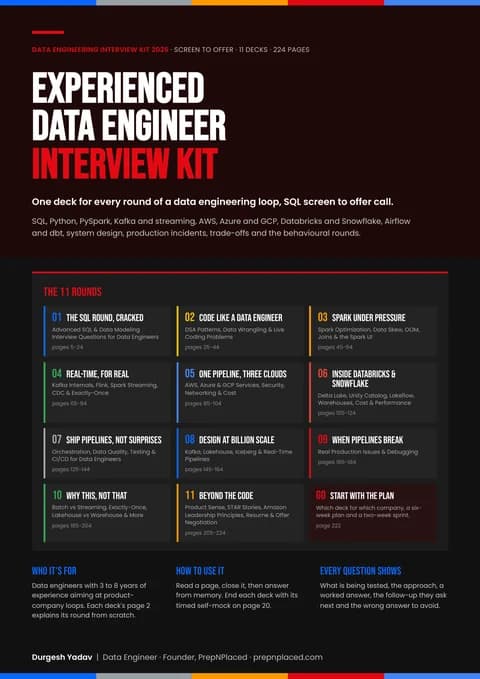
Deck 06, Inside Databricks & Snowflake, covers the databricks and snowflake round. Most Indian product and services teams run on one of these two platforms, and their interviews go deep on it. How each works inside, how to load and model data on it, how to secure it, and how to keep the bill under control.
Real questions from beginner to advanced, each with a concise model answer — practice them, then rehearse live in a mock interview. Every answer is open; collapse any you have already covered.
EasyWhat is the lakehouse architecture and what problem does it solve?
The lakehouse keeps a single copy of data in open formats (Parquet under Delta Lake) on cheap object storage, then layers on what historically forced a separate warehouse: ACID transactions, schema enforcement, fine-grained governance through Unity Catalog, and BI-grade performance via Photon, caching, and data skipping. The problem it solves is the two-copy architecture — a lake feeding a warehouse via ETL — which doubles storage, adds sync jobs that drift, and leaves ML training on stale extracts. The trade-off interviewers probe: object storage is high-latency, so the model depends on table-format maintenance (compaction, clustering, statistics) to actually hit warehouse-class performance.
EasyWhat is Delta Lake and how does it achieve ACID transactions?
Delta Lake is an open table format: Parquet data files plus a _delta_log directory of ordered JSON commit files — with periodic Parquet checkpoints so readers need not replay the whole log — recording every add/remove action, schema change, and protocol upgrade. A write is atomic because it becomes visible only when its numbered commit file lands; readers always see a consistent snapshot as of one version, never a half-finished write. Concurrent writers use optimistic concurrency control: each transaction validates at commit that no conflicting commit appeared since the version it read, and fails with a Concurrent*Exception rather than corrupting data. The same log powers schema evolution, time travel, and Change Data Feed.
EasyExplain the medallion architecture.
Bronze stores raw data exactly as ingested — append-only, minimally transformed, cheap insurance that lets you replay history without touching source systems again. Silver holds cleaned, deduplicated, conformed entities with enforced schemas and quality expectations; Gold holds business-level aggregates and marts consumed by BI and ML. Each hop is incremental, so a logic bug is fixed by rebuilding from the layer below rather than re-extracting from sources. The nuance interviewers want: it is a quality contract, not a rigid rule of three — teams add or collapse layers — but the invariant is that raw stays immutable and every derived layer is reproducible from the one beneath it.
EasyWhat is the difference between all-purpose clusters and job clusters?
All-purpose (interactive) clusters are long-lived, shared by people in notebooks, and billed at a materially higher DBU rate; job clusters are created by a job run, exist only for that run, and terminate when it finishes, at a cheaper rate and with per-run isolation — one job's library or config change cannot break another's. The production rule: humans on all-purpose or serverless, every scheduled workload on job clusters or serverless jobs compute. The follow-up interviewers probe is cost hygiene: an always-on interactive cluster running nightly ETL is the classic red flag, and auto-termination plus cluster policies are how you prevent it organisation-wide rather than team by team.
EasyHow does Delta Lake time travel work?
Every commit creates a new table version, so you can query the past with SELECT ... VERSION AS OF n or TIMESTAMP AS OF, audit changes with DESCRIBE HISTORY, and roll back with RESTORE TABLE — which is itself a new commit, so history is preserved rather than rewritten. Reach is bounded by two retention settings: delta.logRetentionDuration (default 30 days) for commit history and delta.deletedFileRetentionDuration (default 7 days) for the removed data files that old versions still reference. The trap interviewers test: VACUUM permanently deletes files past that retention, so aggressive vacuuming silently breaks time travel — and can break lagging streaming readers that still reference those files.
MediumWhat do OPTIMIZE and Z-ORDER do, and when do you run them?
OPTIMIZE bin-packs many small files into roughly 1 GB files, fixing the small-file problem created by streaming and frequent small writes — fewer files means less listing and task-scheduling overhead per scan. ZORDER BY additionally co-locates related values across files so per-file min/max statistics can skip most of the table on high-cardinality filter columns like customer_id, which hive-style partitioning handles badly. Run OPTIMIZE on a schedule after heavy write windows, Z-ORDERing on your top filter columns; note Z-ORDER is not incremental — it rewrites the data it touches. On current runtimes the forward-looking answer is liquid clustering (CLUSTER BY), which replaces both partitioning and Z-ORDER and re-clusters incrementally.
MediumHow does Auto Loader work and why prefer it over COPY INTO?
Auto Loader is the cloudFiles Structured Streaming source. It discovers new files by directory listing or, at scale, cloud file-notification mode, and records processed files in a RocksDB-backed checkpoint so each file is ingested exactly once even across restarts. It infers the schema, evolves it as new columns appear, and shunts unparseable values into the _rescued_data column instead of dropping rows. COPY INTO is the simpler idempotent SQL alternative, fine for occasional batch loads of thousands of files; Auto Loader scales to millions and runs continuously or as a cheap incremental batch with Trigger.AvailableNow. The follow-up: notification mode avoids re-listing huge directories, which is exactly what kills listing-based ingestion at scale.
MediumWhat is Unity Catalog and what does its object model look like?
Unity Catalog centralises governance across every workspace attached to it: one metastore (typically per region) containing catalogs, then schemas, then securables — tables, views, volumes, functions, and models — addressed by the three-level namespace catalog.schema.table. Access control is ANSI GRANT/REVOKE on those objects, inherited down the hierarchy, with row filters and column masks for fine-grained control. It also provides automatic column-level lineage, audit logs, and Delta Sharing for cross-organisation sharing. The contrast interviewers want: it replaces per-workspace Hive metastores and cluster-scoped ACLs, so permissions and discovery are defined once, centrally, instead of being re-implemented per workspace and per cluster.
MediumWhat is Photon and when does it actually help?
Photon is Databricks' native vectorised execution engine, written in C++, that transparently replaces JVM execution for supported Spark SQL and DataFrame operators — no code changes, with seamless fallback for unsupported ones. It shines on SQL-heavy work — scans, joins, aggregations over Delta and Parquet — and is the engine inside Databricks SQL warehouses. It does not accelerate RDD code or per-row Python UDF logic, so a UDF-heavy pipeline sees little gain. The cost nuance interviewers probe: Photon compute carries a higher DBU rate, so the honest answer is that it usually lowers total cost by finishing faster — but you verify with cost per run from billing data rather than assuming, and skip it where unsupported operations dominate.
MediumWhat are Delta Live Tables (DLT) and expectations?
DLT — now branded Lakeflow Declarative Pipelines — lets you declare streaming tables and materialised views in SQL or Python (@dlt.table) while the framework derives the dependency DAG and manages compute, retries, and incremental processing. Expectations are declarative data-quality rules — CONSTRAINT valid_id EXPECT (id IS NOT NULL) with ON VIOLATION DROP ROW or FAIL UPDATE — whose violation counts land in the pipeline event log, giving observable quality metrics per run; the default action keeps the row but records the violation. It is the standard answer for medallion pipelines because it removes hand-rolled orchestration and checkpoint management; the trade-off is less control over execution details than bespoke jobs give you.
MediumHow do you implement CDC and upserts into Delta tables?
For batch, MERGE INTO target USING source ON key handles inserts, updates, and deletes in one atomic statement. For streaming, run the MERGE per micro-batch inside foreachBatch — MERGE is not a native streaming sink — or use DLT's APPLY CHANGES INTO, which orders out-of-sequence events via a SEQUENCE BY column and maintains SCD Type 1 or Type 2 targets declaratively. To propagate row-level changes downstream, enable Change Data Feed (delta.enableChangeDataFeed) and consume inserts, updates, and deletes with readChangeFeed. The follow-ups interviewers probe: deduplicate the source batch first, since duplicate keys make MERGE fail on multiple matches, and align the MERGE predicate with partitioning or clustering to avoid concurrent-write conflicts.
MediumManaged vs external tables in Unity Catalog — differences and when to use each?
Managed tables have files owned and placed by Unity Catalog under the catalog or schema's managed storage location: DROP TABLE deletes the data — files are cleaned up after a retention window, and UNDROP can recover the table for a limited time — and platform features like predictive optimization apply. External tables register data at an explicit cloud path via an external location and storage credential; DROP removes only metadata and the files stay put. Default to managed for anything new, keeping governance and lifecycle in one place. Choose external when other engines read or write the same files directly, when data must live in a specific bucket for compliance, or mid-migration from hive_metastore using SYNC.
HardHow does Delta handle concurrent writers, and how do you fix a ConcurrentAppendException?
Writers use optimistic concurrency: each transaction records the table version it read, does its work, then validates at commit that no conflicting commit landed in between — if one did, it fails with ConcurrentAppendException or ConcurrentDeleteReadException. Mitigations: make concurrent operations touch disjoint data and express that disjointness in the MERGE or UPDATE predicate (include the partition or clustering column so Delta can prove non-overlap), serialise jobs that write the same keys, and add application-level retries for the residual cases. Partitioning or liquid clustering aligned with writer boundaries removes most conflicts; also know the isolation trade-off — WriteSerializable (default) permits some read-write anomalies that strict Serializable forbids.
HardA Databricks job is slow and expensive. Walk through your tuning approach.
Start in the Spark UI: find the longest stage and check for skew (one straggler task), shuffle spill to disk, and scans over huge numbers of small files. Typical fixes: let AQE coalesce shuffle partitions and split skewed joins, broadcast the small side of joins, restructure logic to cut shuffles, and compact inputs with OPTIMIZE or auto compaction so scans read fewer, larger files. On infrastructure: right-size worker type and count, enable autoscaling, turn on Photon for SQL-heavy stages, and move the job off any all-purpose cluster onto job or serverless compute. Then prove the win with cost per run from system.billing.usage before and after — interviewers want the measurement step, not just a list of knobs.
HardDesign a production streaming pipeline from cloud storage to Gold on Databricks.
Auto Loader with file notifications ingests raw files into a Bronze streaming table, with _rescued_data capturing malformed records instead of dropping them; Silver applies expectations, watermark-based deduplication, and APPLY CHANGES or foreachBatch MERGE for CDC; Gold builds materialised aggregates for BI. Implement it in DLT so the DAG, retries, and incremental compute are managed — choosing continuous mode for low latency or Trigger.AvailableNow on a schedule when minutes of latency are acceptable and cost matters. Checkpoints make each hop exactly-once, Unity Catalog supplies lineage and grants, and VACUUM retention is tuned so streaming readers never lose files they still reference. Close with monitoring: the DLT event log feeds quality and latency alerts.
HardHow would you control and attribute Databricks costs across teams?
Enforce cluster policies that pin allowed node types and autoscaling ranges and mandate auto-termination; require job clusters or serverless for scheduled work, with spot workers plus on-demand fallback for fault-tolerant stages. Tag clusters, jobs, and warehouses by team and project, then attribute spend through system tables — system.billing.usage joined to list_prices — into a chargeback dashboard with alerts on anomalies. Then hunt the classics: always-on interactive clusters running ETL, oversized drivers, continuous streams that could run Trigger.AvailableNow on a schedule, and unoptimised tables forcing full scans. The interview point: policies prevent waste up front, attribution makes teams own what remains — you need both.
By company
Analytics Engineer interviews that ask these questions
See how this topic shows up in real Analytics Engineer loops — rounds, difficulty and company-specific questions:
Do I need deep Spark knowledge for Databricks interviews?
Yes — for data engineer roles, Databricks rounds almost always include Spark internals: shuffles, partitions, AQE, skew handling, and broadcast joins, alongside Delta and Unity Catalog questions. You cannot tune a Databricks job without reading the Spark UI, and interviewers know it. Treat PySpark coding as a guaranteed round.
Which Databricks certification matters for Indian roles?
The Databricks Certified Data Engineer Associate is the standard entry signal, and Professional carries weight for senior roles at GCCs. Services companies value it for client shortlisting; product companies care more about scenario answers. Pair it with a cloud certification on your employer's platform since most Indian Databricks work runs on Azure.
What do Databricks engineers earn in India?
This page quotes no pay figures. PrepNPlaced's India Tech Hiring Report found that fewer than 300 of its postings disclosed an INR salary, too few to publish honestly. Experience and company type set the scale, and Databricks-plus-Spark profiles usually get stronger offers than generic ETL backgrounds. Streaming and Unity Catalog governance experience strengthens an offer further.
Azure Databricks vs AWS Databricks — does the cloud matter for interviews?
The product is the same on every cloud, and interview questions are nearly all platform-agnostic — Delta Lake, clusters, Unity Catalog, and DLT behave identically. Only the integration edges differ: ADLS and Azure Data Factory versus S3 and Glue. Indian JDs skew heavily Azure, so knowing ADLS mounting and ADF orchestration patterns helps.
What is Databricks used for?
Building and running data pipelines on Spark: batch ETL into Delta Lake tables, streaming, SQL analytics through SQL warehouses for dashboards, and machine learning on the same tables. Companies pick it to stop assembling and running their own Spark clusters. In India it is a data engineering skill first: 19.1% of 1,470 data-engineer postings in PrepNPlaced's India Tech Hiring Report, 23 August to 27 September 2026, named Databricks.
What is the difference between Databricks and Azure Databricks?
Azure Databricks is Databricks running as a service on Microsoft Azure: the same Spark, Delta Lake, notebooks, jobs, SQL warehouses and Unity Catalog, connected to Azure storage (ADLS) and Azure Data Factory. Databricks on its own is the platform, which also runs on AWS and Google Cloud. Interview questions are the same on every cloud; only the integrations differ, and Indian job descriptions lean Azure.
What is the difference between a view and a materialized view in Databricks?
A view stores only the query: Databricks runs it each time you read the view, so the result is always current and every read pays for the full query. A materialized view stores the result and refreshes it, inside a pipeline or on a schedule, so reads are fast but only as fresh as the last refresh. Use a view for light logic and a materialized view for heavy aggregates that are read often.
Next Step
Turn The Guide Into Practice
Use PrepNPlaced tools to turn this learning path into resume proof, targeted practice, and interview-ready explanations.