New book · 100 pages · PDF
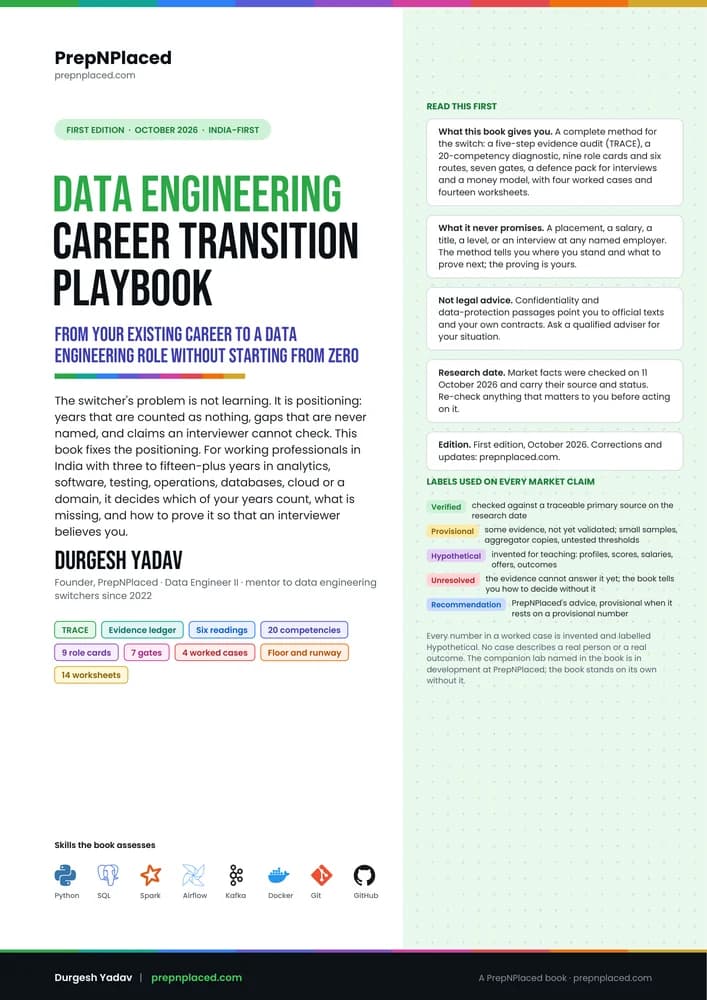
Data Engineering Career Transition PlaybookFrom Your Existing Career to a Data Engineering Role Without Starting From Zero
Your years count. This book shows which ones, what is missing, and how to prove it.
By Durgesh Yadav · Founder · Senior Data Engineer @ 7-Eleven · First edition, October 2026
₹299Launch price
Until 11:59 pm IST on 30 October 2026. From 31 October it is ₹499.
One payment. PDF, yours to download again any time.
Included free for learners in the AI-Powered Data Engineering cohort and in 1:1 mentorship: sign in with the email you enrolled with.
No placement or salary promised. The book says so on page 1, and it never promises a title, a level or an interview either.
- competencies, each with level descriptors and an interviewer probe
- 20competencies, each with level descriptors and an interviewer probe
- role cards, with six routes and a decision tree
- 9role cards, with six routes and a decision tree
- gates, each checked by evidence you can show
- 7gates, each checked by evidence you can show
- worksheets, from the posting decoder to the money model
- 14worksheets, from the posting decoder to the money model
Who it is for
Working professionals moving into data engineering
People in India with three to fifteen-plus years in analytics, software, testing, operations, databases, cloud or a domain. Chapter 3 places you in one of ten segments. Many readers straddle two rows; the book says to use the one whose "commonly overestimated" column makes you wince.
| Segment | Transfers well | Commonly overestimated | Main risk |
|---|---|---|---|
| A Non-technical switcher | Process thinking, SLAs, documentation | Excel as programming; ERP use as systems knowledge | Long retraining with a pay reset |
| B Domain specialist | What the data means; reconciliation logic; regulation | Consuming reports as working with data | Changing industry and function at once |
| C Business analyst | Requirements, KPI definitions, UAT | Specifying a pipeline as building one | Never shipping code |
| D Data analyst or BI developer | Analytical SQL, metric logic, validation | Dashboard SQL as pipeline SQL; refresh schedules as orchestration | Being read as "an analyst who knows SQL" |
| E SQL developer or DBA | Deep SQL, plans, indexing, change data capture | Single-node tuning carrying over to distributed engines | Legacy framing in interviews |
| F Software developer | Code, tests, CI, on-call | OLTP design as analytical modelling | Data correctness treated as an afterthought |
| G QA or automation tester | Test design, automation, validation SQL | Validating tables as building pipelines | Kept in testing roles |
| H Cloud or DevOps engineer | Cloud, infrastructure as code, IAM, monitoring, cost | Provisioning a service as engineering on it | Weak SQL and business-logic rounds |
| I Data scientist or ML | Python, statistics, feature work | Notebooks as production | Notebook habits under production questions |
| J 10 to 15+ years outside data | Delivery leadership, architecture exposure, vendors | Managing builders as building; title as DE level | Largest absolute pay at risk |
From pages 14 and 15, which are free to read. Page 15 also gives each segment's learning order and first proof.
Who it is not for
- Students and freshers. The method sorts years of work you already have. If you are starting out, read Data Engineering: From Zero to Production & Interview Ready, our free book, first.
- Anyone after a course. The book explains the 20 competencies, how each is tested and in what order to build them. It teaches none of them.
- Anyone who wants a guarantee. It promises no placement, salary, title, level or interview. It tells you where you stand and what to prove next.
The problem
Why experienced switchers get mispositioned
Chapter 1 opens with the two wrong positions experienced switchers end up in: a fresher whose years count for nothing, or a data engineer who cannot defend the title. Both end in a rejection that tells you nothing. Three invented people show how it happens.
INVENTED EXAMPLE
The analyst who over-claims
Five years as an analyst, strong SQL, three scheduled jobs she keeps alive for forty category managers. Her resume says "owned the company's data pipelines". The second interviewer asks what happened when a job ran twice, and she has never thought about it. Every true thing on the resume is now read as possibly false.
INVENTED EXAMPLE
The operations manager who applies as a fresher
Nine years running warehouse operations, with reconciliation rules in his head that a data team would pay for. A roadmap told him to learn Python, build three projects and apply for entry-level roles. He applies alongside graduates, his years invisible, and concludes his experience is worthless. It was never assessed.
INVENTED EXAMPLE
The developer who undersells
Eight years in backend engineering, on-call for two of them, producing the events a data team consumes. He writes "some exposure to data pipelines" because he does not have the title, and applies for junior roles at a third of his pay. A platform team would have hired him at level for the production ownership alone.
All three have the same problem from different directions: nobody separated what their experience shows from what it does not. Read chapter 1 free
How to use it
The method on one screen
The book calls itself a decision book, not a course. Each chapter answers one question and ends with something you have made. By chapter 14 you have a file on yourself that a recruiter, an interviewer or a mentor can read.
| Ch. | The decision | What you make | Gate |
|---|---|---|---|
| 1 | What are my years worth today? | One dated paragraph, to be tested against evidence | |
| 2 | What does the job ask for? | Five decoded postings (W2 header) | |
| 3 | Where do I stand, measured? | Diagnostic score sheet and target-role profile (W1, W2); ranked gap list | G1 |
| 4 | What does my past demonstrate? | TRACE worksheet (W3), confidentiality check (W10), evidence ledger (W4) | |
| 5 | Which role, level and route? | A target statement (W8) | |
| 6 | Which gaps, in which order? | Gap list mapped to modules | |
| 7 | When will I know I am ready? | A dated plan with seven gates (W7) | |
| 8 | What proof survives questions? | One to three projects with rubric scores (W5), drill sheets (W11), collaboration record (W13) | G2, G3, G4 |
| 9 | Can I build evidence at work? | A manager proposal or transfer plan (W9) | |
| 10 | What may I write? | A resume, LinkedIn profile and three notes, every line traced to the ledger | G5 |
| 11 | Why am I changing? | An answer bank for the ten transition questions | |
| 12 | How deep can they go? | Defence packs; two scored mocks (W6) | G6 |
| 13 | Can I afford it? | Floor, runway and offer matrix (W14) | |
| 14 | Is it working? | Application log (W12); a monthly decision (W8) | G7 |
“Whatever the path, read Chapter 5 before you apply anywhere and Chapter 13 before you resign from anywhere.”Page 5
What is inside
What the 100 pages hold
TRACE, a five-step evidence audit
Take inventory, record ownership, assign a category, check the evidence twice, express it honestly. One responsibility at a time, so you know what you may claim and at what strength.
20 competencies
Each with what Levels 2 to 4 look like and one question an interviewer would ask. You score yourself against one real posting.
9 role cards and 6 routes
From junior DE to data engineering manager, with analytics engineer, platform, data quality, domain data and leadership hybrid in between. A four-question decision tree picks the route to test first.
7 gates
Technical fundamentals, project implementation, data correctness, failure recovery, resume evidence, interview defence and target-role readiness. Each is checked by evidence you can show, with a protocol for a failed gate.
The defence pack
A 30-second, a two-minute and a deep version of every project and ownership claim, eight follow-up trees and a scored mock-interview sheet.
The money model
Your financial floor and runway from your own payslip, EMIs and savings, then an offer matrix. A route that cannot clear your floor is set aside before anything is scored.
14 worksheets
From the posting decoder and the TRACE worksheet to the evidence ledger, the gate tracker, the application log and the offer matrix.
4 invented case files
A mechanical engineer, a data analyst, a software developer and an SAP delivery manager, each followed from first diagnostic to offer decision. Labelled as invented throughout.
Contents: five parts, 14 chapters and nine appendices
Part I · Understand
- 1Why experienced switchers get mispositionedfree to readp. 6
- 2What DE roles ask for, and how to read a postingfree to readp. 10
Part II · Assess
- 3Your starting point: segments and the diagnosticopening pages freep. 14
- 4TRACE: your experience and your evidencep. 20
- 5Readiness, level and routep. 28
Part III · Build and prove
- 6The 20 competencies: what good looks like and how it is testedp. 36
- 7Milestone-driven plansp. 41
- 8Proof that survives questionsp. 46
- 9Building evidence inside your current jobp. 52
Part IV · Position
- 10The honest resume, LinkedIn and evidence ledgerp. 56
- 11Telling the transition storyp. 63
Part V · Compete
- 12Interview defencep. 67
- 13Pay, risk and the offer decisionp. 73
- 14Running the searchp. 79
Appendices and worksheets
- A1Diagnostic score sheet and target-role profile (W1 and W2)p. 83
- A2TRACE worksheet with the confidentiality check (W3 and W10)p. 84
- A3Evidence ledger (W4)p. 85
- A4Project rubric and gate tracker (W5 and W7)p. 86
- A5Interview defence scorecard and remediation (W6)p. 87
- A6Readiness review (W8)p. 88
- A7Glossaryp. 89
- A8Sources and further resourcesp. 94
- A9The four case filesp. 95
- About the authorfree to readp. 99
How it treats evidence
Every market claim carries a label
Market facts in the book were checked on 11 October 2026, and each one carries its source and one of five labels. A code such as L02 points to the row in the research ledger (Appendix A8) that holds the source, its date and its limits. Check anything that matters to you again before you act on it.
Every person in a worked example is invented, and so are their scores, pay and offers. The book labels them Hypothetical wherever they appear.
- VERIFIED
- Checked against a traceable primary source on the research date.
- PROVISIONAL
- Some evidence, not yet validated: small samples, aggregator copies, untested thresholds.
- HYPOTHETICAL
- Invented for teaching: profiles, scores, salaries, offers, outcomes.
- UNRESOLVED
- The evidence cannot answer it yet; the book tells you how to decide without it.
- RECOMMENDATION
- PrepNPlaced's advice, provisional when it rests on a provisional number.
Free sample
Read 20 of the 100 pages free
Pages 1-15, 24-25, 32 and 99-100: the cover and notices, the contents and how to use the book, chapters 1 and 2 in full, the ten segments, the verb contract with its strong and weak mappings, the route decision tree, the author and the back cover.
Checking your access to the book…
Which route to test
Four questions from Chapter 5
The book's decision tree asks four yes-or-no questions in order and stops at the first yes. Each yes names a route worth testing and the role card to check it against.
- 1
Have you defended E1 work, and does your profile meet the target JD?
E1 work is code or configuration you wrote or maintained that moved or transformed data repeatedly, without you in the loop, and that other people depended on (Chapter 4). Defended means you passed an oral defence of it, scored by someone other than you (Chapter 12).
- 2
Does your employer have a data team with an opening you can reach?
- 3
Do target job descriptions in your industry name your domain?
- 4
Is your profile at the JD core level, with one project you can defend?
A "yes" points to a route worth testing, not a route to take. From page 32, which is free to read.
Help running the method
Work through the method with a mentor
The book is written to be run on your own, or with a peer or a mentor. If you want Durgesh as that mentor, his 1:1 mentorship starts with a free intro call, where you can check whether it fits.
Joining AI-Powered Data Engineering Cohort 4? Enrolment is open until 30 October, and this book comes with your seat. See the cohort

About the author
Durgesh Yadav
Founder · Senior Data Engineer @ 7-Eleven
Durgesh made the move this book describes. He started as a data analyst at Coforge, worked as a product analyst at Target, and moved into data engineering at 7-Eleven in 2024. He has mentored people one to one since 2022 and teaches the AI-Powered Data Engineering cohort at PrepNPlaced.
“Every week I meet someone with six, eight or twelve good years who has been told to start again. Most of the time that advice is wrong.”Why I wrote this book, page 99
Corrections and updates
Corrections
The book says that errors found after publication, and updates to its market facts, are posted on prepnplaced.com. They are posted here, newest first, with the page each one changes.
No corrections yet. First edition, October 2026. Last checked .
Questions
Before you buy
Is it a course?
No. It is a 100-page PDF book. The book calls itself a decision book: each chapter ends with something you make, a decoded posting, a worksheet, a plan, a resume or a money model. It explains the 20 competencies and how each is tested, but it teaches none of them.
Is the companion lab included?
No. The book mentions a companion lab that is still being built at PrepNPlaced. It is not part of this purchase and has no release date. The book works without it: wherever it names a lab module, form or answer key, it also tells you how to do the same work now with a peer or a mentor.
Is it for freshers?
No. It is written for working professionals with three to fifteen-plus years in analytics, software, testing, operations, databases, cloud or a domain. If you are a student or a fresher, start with the free Data Engineering book. Read the free Data Engineering book
Does it promise a job or a salary?
No. The book says on its first page that it never promises a placement, a salary, a title, a level, or an interview at any named employer. It tells you where you stand and what to prove next.
What does it cost?
₹299 until 11:59 pm IST on 30 October 2026, then ₹499. One payment, no subscription.
How do I get the PDF after paying?
Sign in with Google, pay through Cashfree, and a Download button appears on this page. The book stays on your account, and you can download it again whenever you sign in.
Is it included in my cohort or mentorship?
Yes, if you are a learner in the AI-Powered Data Engineering cohort, past or present, or in 1:1 mentorship with Durgesh. Sign in with the email you enrolled with and the Download button appears in place of the price.
Is it part of the Learn Pass, the notes vault or a plan?
No. The book is sold on its own. The Learn Pass, the notes vault and the paid plans do not include it.
Can I print the worksheets?
Yes, for your own use. The book's notice on page 2 lets a buyer print or photocopy the worksheets in Appendices A1 to A6. The PDF is A4 and prints on A4 paper.
Can I get a refund?
Refunds are handled under our Refund Policy. If something is wrong with your copy, email support@prepnplaced.com from the address you paid with and include your order id. Read the Refund Policy