PROJECT 1 · M02-M04
Batch lakehouse
Raw files to bronze, silver and gold Delta tables with incremental loads and quality checks
Stack: S3, PySpark, Databricks, Delta Lake, Workflows
1:1 mentorship with Durgesh Yadav · Live 1:1 classes, doubt support, interview support
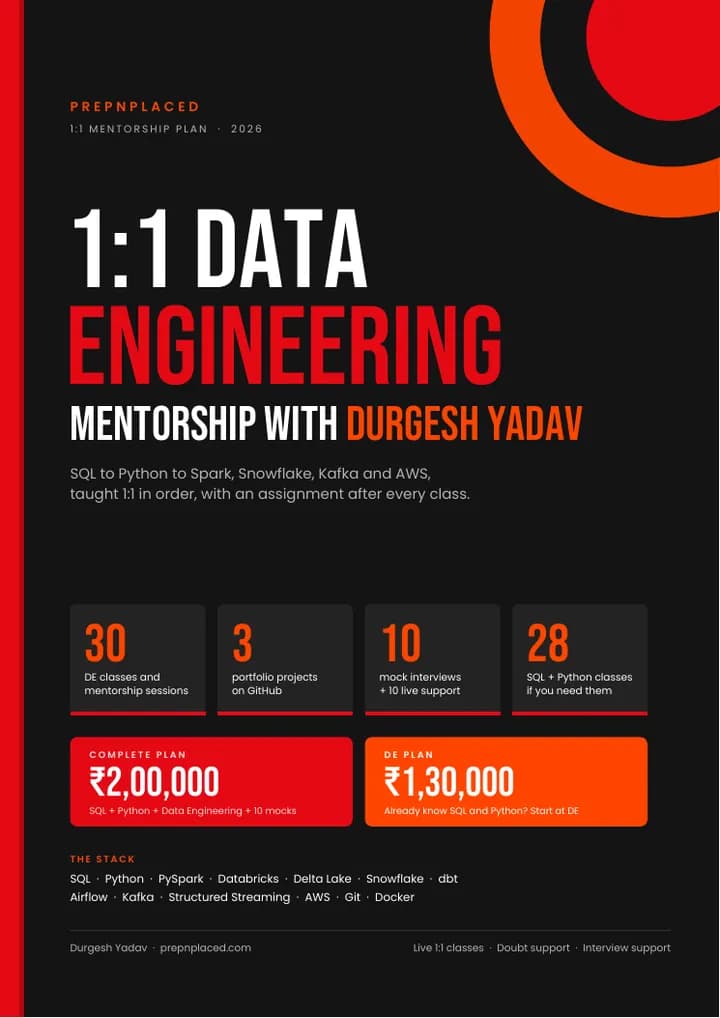
SQL to Python to Spark, Snowflake, Kafka and AWS, taught 1:1 in order.
A 1:1 mentorship with Durgesh Yadav that takes you from where you are today to building, running and defending production-style pipelines on the modern data stack, with an assignment after every class.
Complete plan
₹2,00,000
SQL + Python + Data Engineering + 10 mocks
DE plan
₹1,30,000
Already know SQL and Python? Start at Data Engineering
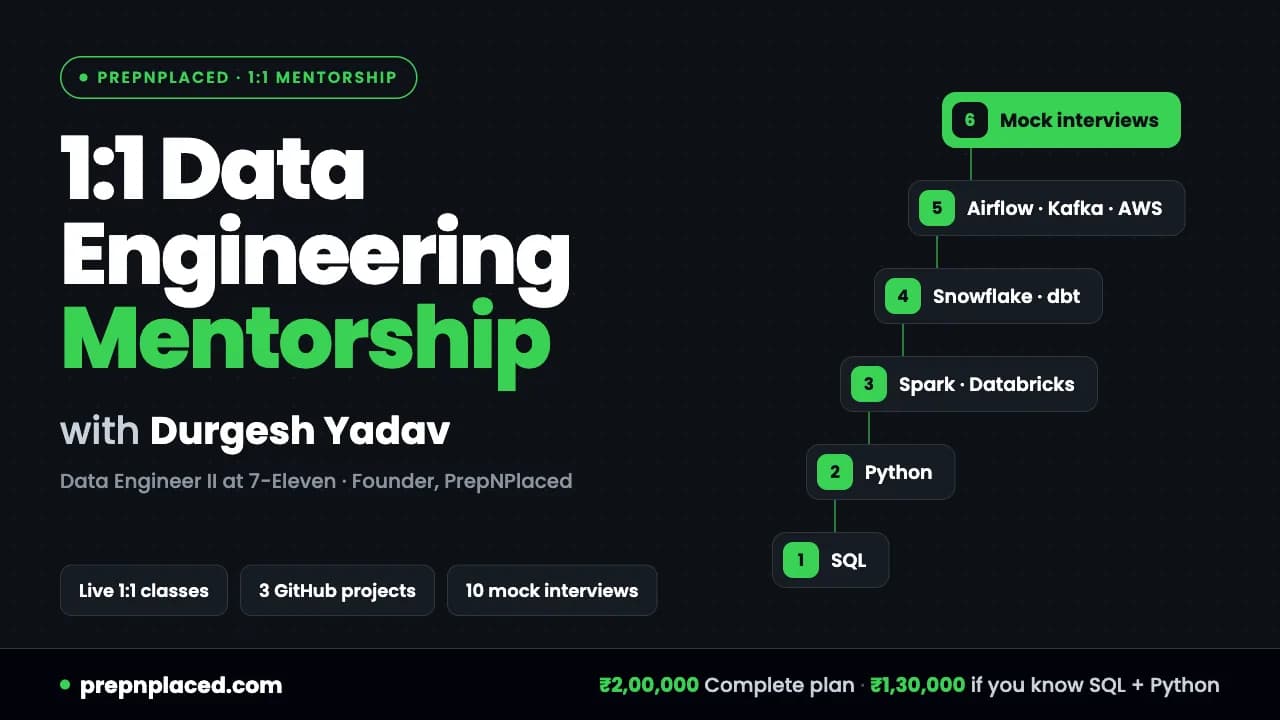
The stack: SQL · Python · PySpark · Databricks · Delta Lake · Snowflake · dbt · Airflow · Kafka · Structured Streaming · AWS · Git · Docker
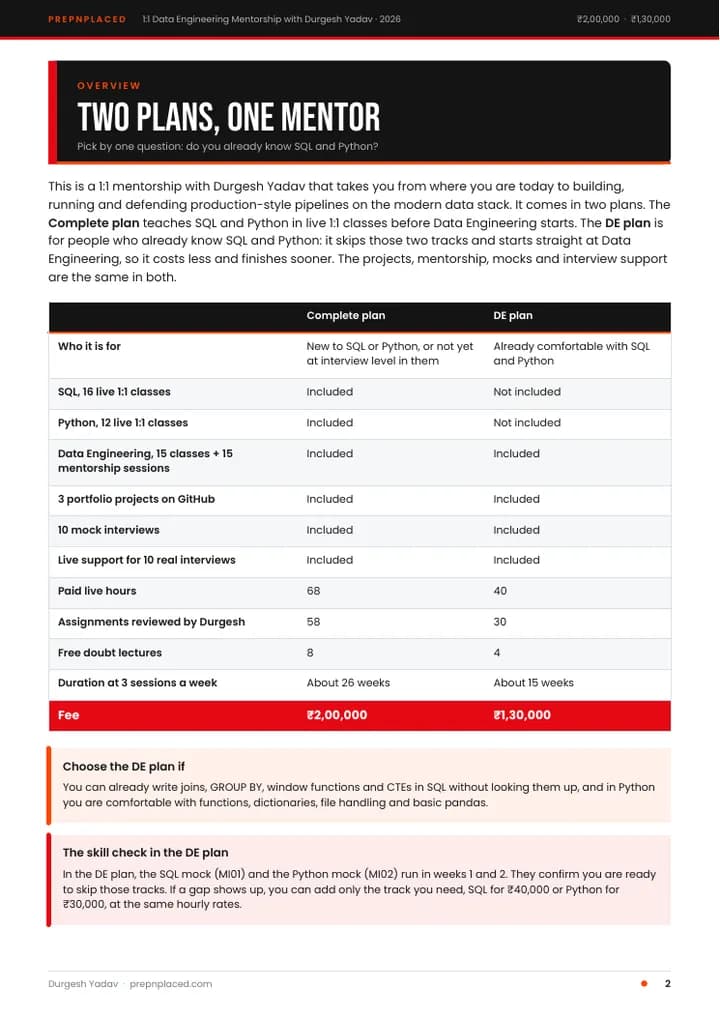
Two plans, one mentor
Complete plan
New to SQL or Python, or not yet at interview level in them
DE plan
Already comfortable with SQL and Python
Choose the DE plan if you can already write joins, GROUP BY, window functions and CTEs in SQL without looking them up, and in Python you are comfortable with functions, dictionaries, file handling and basic pandas.
The skill check in the DE plan. In the DE plan, the SQL mock (MI01) and the Python mock (MI02) run in weeks 1 and 2. They confirm you are ready to skip those tracks. If a gap shows up, you can add only the track you need, SQL for ₹40,000 or Python for ₹30,000, at the same hourly rates.
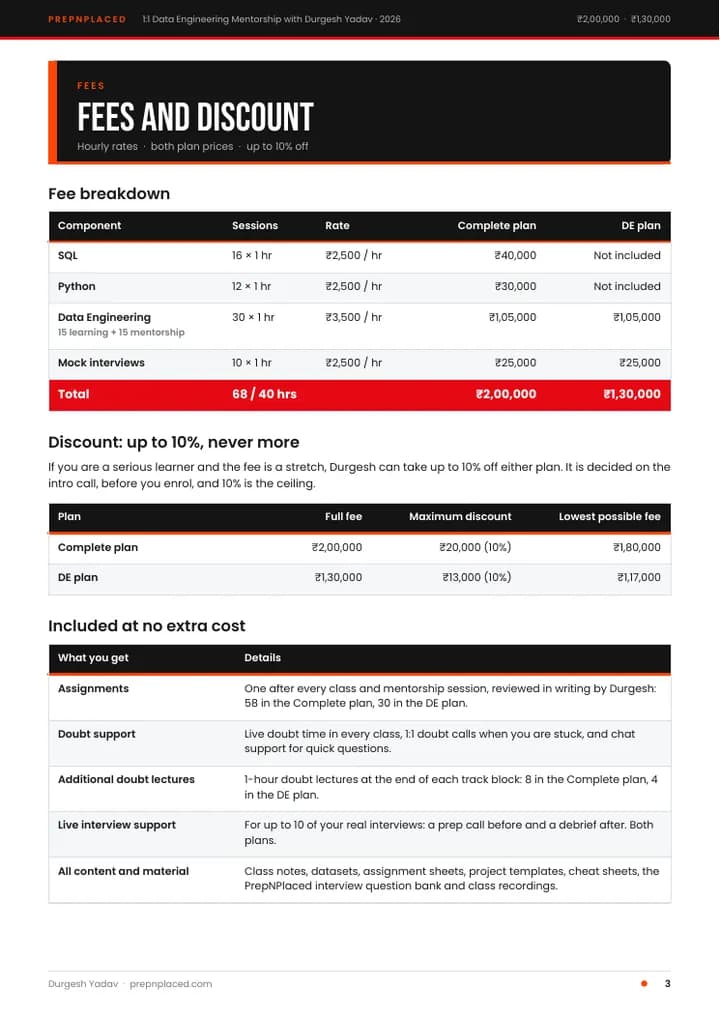
Fees and discount
Complete plan₹2,00,000
DE plan₹1,30,000
Discount: up to 10%, never more
If you are a serious learner and the fee is a stretch, Durgesh can take up to 10% off either plan. It is decided on the intro call, before you enrol, and 10% is the ceiling.
Included at no extra cost
How it works
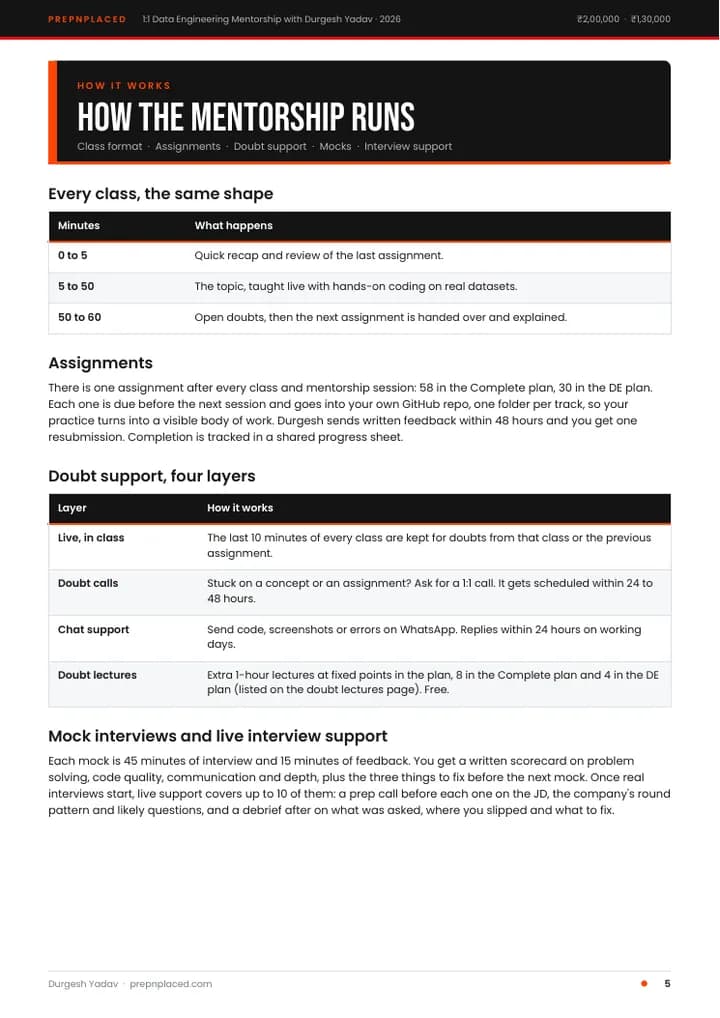
There is one assignment after every class and mentorship session: 58 in the Complete plan, 30 in the DE plan. Each one is due before the next session and goes into your own GitHub repo, one folder per track, so your practice turns into a visible body of work. Durgesh sends written feedback within 48 hours and you get one resubmission. Completion is tracked in a shared progress sheet.
Each mock is 45 minutes of interview and 15 minutes of feedback. You get a written scorecard on problem solving, code quality, communication and depth, plus the three things to fix before the next mock. Once real interviews start, live support covers up to 10 of them: a prep call before each one on the JD, the company's round pattern and likely questions, and a debrief after on what was asked, where you slipped and what to fix.
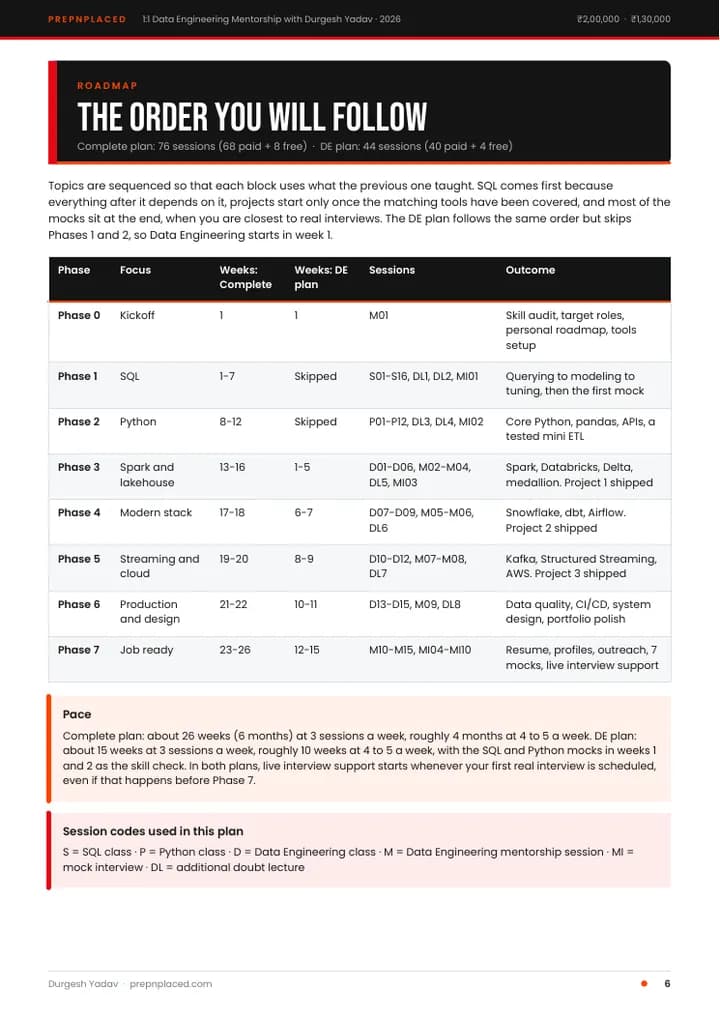
Roadmap
Phase 0 · Kickoff
Complete: Week 1 · DE plan: Week 1
M01
Skill audit, target roles, personal roadmap, tools setup
Phase 1 · SQL
Complete: Weeks 1-7 · DE plan: Skipped
S01-S16, DL1, DL2, MI01
Querying to modeling to tuning, then the first mock
Phase 2 · Python
Complete: Weeks 8-12 · DE plan: Skipped
P01-P12, DL3, DL4, MI02
Core Python, pandas, APIs, a tested mini ETL
Phase 3 · Spark and lakehouse
Complete: Weeks 13-16 · DE plan: Weeks 1-5
D01-D06, M02-M04, DL5, MI03
Spark, Databricks, Delta, medallion. Project 1 shipped
Phase 4 · Modern stack
Complete: Weeks 17-18 · DE plan: Weeks 6-7
D07-D09, M05-M06, DL6
Snowflake, dbt, Airflow. Project 2 shipped
Phase 5 · Streaming and cloud
Complete: Weeks 19-20 · DE plan: Weeks 8-9
D10-D12, M07-M08, DL7
Kafka, Structured Streaming, AWS. Project 3 shipped
Phase 6 · Production and design
Complete: Weeks 21-22 · DE plan: Weeks 10-11
D13-D15, M09, DL8
Data quality, CI/CD, system design, portfolio polish
Phase 7 · Job ready
Complete: Weeks 23-26 · DE plan: Weeks 12-15
M10-M15, MI04-MI10
Resume, profiles, outreach, 7 mocks, live interview support
Complete plan: about 26 weeks (6 months) at 3 sessions a week, roughly 4 months at 4 to 5 a week. DE plan: about 15 weeks at 3 sessions a week, roughly 10 weeks at 4 to 5 a week, with the SQL and Python mocks in weeks 1 and 2 as the skill check. In both plans, live interview support starts whenever your first real interview is scheduled, even if that happens before Phase 7.
Session codes: S = SQL class · P = Python class · D = Data Engineering class · M = mentorship session · MI = mock interview · DL = doubt lecture
Every session
From the first SELECT to the modeling, tuning and interview patterns that data engineering rounds test. Doubt lectures DL1 (after S08) and DL2 (after S16), then mock MI01. Complete plan only.
S01 · SQL foundations: SELECT, WHERE, ORDER BY
Covers: How a query actually runs (FROM › WHERE › GROUP BY › HAVING › SELECT › ORDER BY), SELECT and aliases, WHERE with AND / OR / IN / BETWEEN / LIKE, how NULL behaves (IS NULL, COALESCE), ORDER BY and LIMIT.
Assignment: Set up PostgreSQL (or MySQL) and load the course e-commerce dataset: customers, orders, order_items, products. Write 12 queries covering filters, pattern matches, NULL checks and the top 10 orders by amount.
S02 · Aggregations and GROUP BY
Covers: COUNT, SUM, AVG, MIN, MAX. COUNT(*) vs COUNT(col) vs COUNT(DISTINCT). Grouping on several columns, HAVING vs WHERE, conditional aggregation with CASE.
Assignment: Answer 10 business questions: revenue by month, orders per city, customers with more than 3 orders, average basket size by category, and the share of cancelled orders.
S03 · Joins, and the duplicate-row trap
Covers: INNER, LEFT, RIGHT, FULL, SELF and CROSS joins. Choosing join keys, fan-out duplicates that inflate totals, anti-joins (customers with no orders), joining 3+ tables.
Assignment: Solve 12 join questions, including one anti-join and one self-join (employee and manager). Then write one query where a bad join inflates revenue and explain the bug in 3 lines.
S04 · Subqueries
Covers: Scalar subqueries, IN and EXISTS, correlated subqueries, derived tables, and when EXISTS, IN or a JOIN is the better choice.
Assignment: Solve 8 questions twice: once with a subquery and once with a join. For each pair, write which version you would ship and why.
S05 · CTEs and recursive CTEs
Covers: The WITH clause for readable multi-step logic, chaining CTEs, recursive CTEs for hierarchies and for generating date series.
Assignment: Rewrite 3 long queries from S04 using CTEs. Build an org chart with levels using a recursive CTE, and generate a calendar table for 2026.
S06 · Window functions I: ranking
Covers: OVER, PARTITION BY and ORDER BY. ROW_NUMBER vs RANK vs DENSE_RANK, NTILE, and top-N per group.
Assignment: Find the top 3 products per category by revenue and the second-highest salary per department. Deduplicate a table so only the latest row per key survives.
S07 · Window functions II: analytics
Covers: LAG and LEAD, running totals, moving averages, frame clauses (ROWS vs RANGE), FIRST_VALUE and LAST_VALUE.
Assignment: Month-over-month revenue growth %, a 7-day moving average of orders, days between consecutive orders per customer, and cumulative revenue share.
S08 · CASE, strings and dates
Covers: CASE for buckets and flags. String functions (SUBSTRING, CONCAT, TRIM, REPLACE, basic regex). Date functions (DATE_TRUNC, EXTRACT, intervals, date differences), type casting, time zones.
Assignment: Clean a messy customers table (phone formats, name casing, invalid emails) and add a segment column (new / active / dormant) using date logic.
S09 · Deduplication, pivots and set operations
Covers: Finding and removing duplicates, UNION vs UNION ALL, INTERSECT and EXCEPT, pivoting with conditional aggregation, unpivoting.
Assignment: Deduplicate a raw events table, build a month x category revenue pivot, and reconcile two tables with EXCEPT, reporting every mismatch.
S10 · OLTP vs OLAP, and normalization
Covers: Transactional vs analytical systems, primary and foreign keys, constraints, 1NF / 2NF / 3NF with examples, and when to denormalize on purpose.
Assignment: Normalize a flat 20-column sales sheet to 3NF, draw the ER diagram, and write the CREATE TABLE statements with keys and constraints.
S11 · Dimensional modeling
Covers: Facts vs dimensions, declaring the grain, star vs snowflake schema, surrogate keys, fact table types (transaction, periodic snapshot, accumulating snapshot), conformed dimensions.
Assignment: Design a star schema for a food-delivery app: state the grain, list the facts and dimensions, then write 5 analytical queries against it.
S12 · Slowly changing dimensions and MERGE
Covers: SCD Type 1 vs Type 2 (and where Type 3 shows up), effective dates and current flags, MERGE and upsert patterns, idempotent loads.
Assignment: Implement SCD Type 2 on a customer dimension using 3 daily change files and MERGE (or INSERT ... ON CONFLICT). Prove the history is correct with queries.
S13 · Indexes and query tuning
Covers: How B-tree indexes work, column order in composite indexes, reading EXPLAIN and EXPLAIN ANALYZE, sargable filters, the usual causes of slow queries.
Assignment: Take 5 slow queries on a 1M-row table, capture EXPLAIN before and after indexing or rewriting, and write a one-page tuning note.
S14 · Partitioning and clustering in warehouses
Covers: Table partitioning and partition pruning, clustering keys, Snowflake micro-partitions, the cost of full scans, materialized views.
Assignment: Partition the orders table by month, compare how filtered queries scan it, and write down when you would and would not cluster a table.
S15 · Interview query patterns
Covers: Gaps and islands, consecutive-day streaks, top-N per group, retention and cohort queries, median and percentiles, sessionization.
Assignment: Solve 15 questions taken from product-company interview loops, spread across the six patterns, with a short explanation for each.
S16 · SQL inside pipelines
Covers: Transactions and ACID, isolation levels in plain terms, views vs materialized views, incremental loads using a watermark column, data checks written in SQL (row counts, null %, duplicates, reconciliation).
Assignment: Write an incremental load from a staging table to a target using a last-updated watermark, plus 6 SQL data checks that fail loudly when something is off.
Python the way data engineers use it at work: files, APIs, pandas, tests and clean repos. Doubt lectures DL3 (after P06) and DL4 (after P12), then mock MI02. Complete plan only.
P01 · Python basics for data work
Covers: Setup (Python 3.11+, VS Code, Jupyter), variables and types, strings and f-strings, lists and tuples, slicing, if / for / while.
Assignment: 15 short exercises on string cleanup, list slicing and looping over order records. Push them to a new GitHub repo.
P02 · Dictionaries, sets and comprehensions
Covers: Dictionaries for lookups and counting, sets for dedup and membership checks, list / dict / set comprehensions, sorting with key functions.
Assignment: Parse 1,000 order records (a list of dicts) and compute revenue per city, unique customers and the top 5 products without using pandas.
P03 · Functions
Covers: Parameters and defaults, *args and **kwargs, return values, scope, lambda, map / filter / sorted, type hints and docstrings.
Assignment: Build a utility module of 8 reusable cleaning functions (trim, normalize phone, parse date, safe cast and so on) with type hints and docstrings.
P04 · Files, errors and logging
Covers: Reading and writing CSV and JSON, context managers, try / except / finally, custom exceptions, using logging instead of print.
Assignment: Write a script that reads a folder of CSVs, logs and skips bad rows, and writes one clean JSON file plus a separate reject file.
P05 · OOP for pipelines
Covers: Classes and objects, __init__ and methods, inheritance vs composition, dataclasses, and when a class is better than a function.
Assignment: Model an Extractor › Transformer › Loader pipeline as classes. Swap the CSV extractor for a JSON one without touching the loader.
P06 · Project structure and environments
Covers: Modules and packages, virtual environments, pip and requirements.txt, config files and environment variables, .gitignore, a clean repo layout.
Assignment: Restructure your P04 and P05 code into a proper package with a config file, requirements file, README and a single run command.
P07 · Iterators, generators and decorators
Covers: Iterators, generators and yield, processing files bigger than memory, chunking, decorators for timing and retries.
Assignment: Stream a large log file line by line, count errors per hour, and add a retry decorator to a function that fails randomly.
P08 · pandas I
Covers: DataFrame and Series, reading CSV / Parquet / JSON, selecting and filtering, groupby and aggregation, merge and concat, sorting.
Assignment: Answer 10 retail sales questions in pandas and check that the results match your SQL answers from S02 and S03.
P09 · pandas II
Covers: Dates and time series, strategies for missing data, apply vs vectorised operations, pivot_table and melt, dtypes and memory, where pandas stops scaling.
Assignment: Clean a messy 500k-row dataset end to end (types, nulls, duplicates, outliers) and write a before-and-after data profile.
P10 · APIs and databases
Covers: REST basics, requests, auth headers, pagination, rate limits, flattening nested JSON, loading into Postgres with SQLAlchemy or psycopg.
Assignment: Pull paginated data from a public API, flatten it, and load it into Postgres with an upsert so a rerun never creates duplicates.
P11 · Mini ETL project with tests
Covers: The extract › transform › load flow, writing Parquet, config-driven runs, pytest basics, unit testing transform functions.
Assignment: Ship a mini ETL repo: API › clean › Parquet › Postgres, with 5 unit tests, logging, and a README that explains how to run it.
P12 · Python coding round for data engineers
Covers: Patterns DE interviews actually ask: hashmaps, two pointers, sliding window, sorting, string and log parsing, time complexity basics.
Assignment: Solve 15 easy-to-medium Python interview questions and note the time complexity of each solution.
The modern stack in the order a real platform gets built: Spark and the lakehouse, then the warehouse and transformation layer, then streaming and cloud, then quality and design. Doubt lectures DL5 to DL8 sit at the end of each block. Both plans.
D01 · How a modern data platform fits together
Covers: Batch vs streaming, ETL vs ELT, data lake vs warehouse vs lakehouse, file formats (CSV, JSON, Parquet, Avro), table formats (Delta, Iceberg), one reference architecture end to end.
Assignment: Draw the data architecture of an app you use daily (sources › ingestion › storage › transform › serving) and justify each choice in a short paragraph.
D02 · Spark architecture
Covers: Why distributed processing, driver / executors / cluster manager, jobs, stages and tasks, lazy evaluation and the DAG, narrow vs wide transformations, the shuffle.
Assignment: Run a job on Databricks Free Edition, open the Spark UI, and explain its stages, tasks and the shuffle it triggered.
D03 · PySpark DataFrames
Covers: Reading data with an explicit schema, select / filter / withColumn, joins, groupBy, window functions, UDFs vs built-in functions, writing Parquet.
Assignment: Port 8 of your SQL track answers to PySpark and confirm the outputs match.
D04 · Spark optimization
Covers: Partitions, repartition vs coalesce, broadcast joins, data skew and salting, caching, Adaptive Query Execution, the small-files problem.
Assignment: Take a slow join job, diagnose it in the Spark UI, fix it with two techniques, and record the runtime before and after.
D05 · Databricks and Delta Lake
Covers: Workspace, compute and jobs, the Delta transaction log, ACID writes, MERGE, time travel, OPTIMIZE / Z-ORDER / VACUUM, Unity Catalog basics.
Assignment: Create a Delta table, apply MERGE upserts for 3 batches, query an older version with time travel, then run OPTIMIZE on it.
D06 · Medallion architecture and incremental loads
Covers: Bronze / silver / gold layers, full vs incremental loads, CDC basics, watermarks, Auto Loader, idempotency, schema evolution.
Assignment: Design the medallion layers for Project 1: every table, its keys and its load type. Bring it to the M02 session.
D07 · Snowflake
Covers: Storage / compute / services layers, virtual warehouses, stages and COPY INTO, Snowpipe, streams and tasks, time travel, keeping credits under control.
Assignment: Load files into Snowflake with COPY INTO, set up a stream and task for incremental processing, and note the credits you used.
D08 · dbt
Covers: Project structure, sources and refs, staging › marts, materializations, incremental models, tests, snapshots, generated docs.
Assignment: Build staging and mart models on your D07 data with at least 6 tests and one incremental model.
D09 · Apache Airflow
Covers: DAGs, tasks and operators, scheduling and catchup, retries and SLAs, sensors, XComs, backfills, designing tasks that are safe to rerun.
Assignment: Write a daily DAG that runs extract › dbt run › dbt test, with retries and a failure alert.
D10 · Apache Kafka
Covers: Event streaming basics, topics and partitions, producers and consumers, consumer groups and offsets, delivery guarantees, message keys and ordering.
Assignment: Run Kafka in Docker, write a Python producer for order events and a consumer group of two, and show how partitions get assigned.
D11 · Spark Structured Streaming
Covers: The micro-batch model, reading from Kafka, triggers, watermarks and late data, stateful aggregations, checkpoints, writing to Delta.
Assignment: Stream your D10 order events into a Delta table with 5-minute windowed revenue and a 10-minute watermark.
D12 · AWS for data engineering
Covers: S3 layout and storage classes, IAM roles and policies, the Glue catalog and Glue jobs, Athena, Redshift basics, Lambda triggers, watching the bill.
Assignment: Land raw files in S3, catalog them with a Glue crawler, query them in Athena, and trigger a Lambda whenever a new file arrives.
D13 · Data quality and observability
Covers: How pipelines fail silently, tests at each layer, data contracts, freshness and volume checks, alerting, lineage, handling bad records.
Assignment: Add row count, null, uniqueness and freshness checks to Project 1 that fail the job, and write a short runbook for each alert.
D14 · Git, CI/CD and Docker for data
Covers: Branching and pull requests, code review, CI that runs tests on every PR, dev and prod environments, Docker images for jobs, handling secrets.
Assignment: Add a GitHub Actions workflow that lints and tests one project on every PR, and containerize your P11 ETL.
D15 · Data pipeline system design
Covers: A framework for design rounds: requirements › volume › architecture › storage › processing › quality › cost › failure modes. Batch vs streaming trade-offs, three worked designs.
Assignment: Write full designs for two prompts, a ride-hailing trips pipeline and a clickstream analytics platform, using the framework.
These run alongside Track 03. Each project starts only after its tools have been taught, every session reviews your work, and each one ends with a deliverable due before the next. Both plans.
M01 · Kickoff: skill audit and roadmap
Agenda: Where you are vs the role you want, target companies and salary band, weekly hours you can commit, your personal 6-month plan, tools setup.
Deliverable: Fill the skill audit sheet and share your resume, LinkedIn URL and target company list.
M02 · Project 1 kickoff: batch lakehouse
Agenda: Problem statement and dataset, architecture (S3 › PySpark on Databricks › Delta bronze / silver / gold), repo structure, what 'done' means.
Deliverable: Repo created and bronze ingestion running on sample data.
M03 · Project 1 review: bronze and silver
Agenda: Code review of ingestion and cleaning, schema handling, dedup logic and incremental loads.
Deliverable: Silver layer complete, with incremental loads tested on 3 batches.
M04 · Project 1 review: gold and scheduling
Agenda: Gold tables for business metrics, a Databricks Workflows job, quality checks, README review.
Deliverable: Project 1 finished and pushed with an architecture diagram.
M05 · Project 2 kickoff: Snowflake + dbt
Agenda: Analytics engineering use case, raw › staging › marts design, naming conventions, test plan.
Deliverable: Raw data loaded in Snowflake and staging models built.
M06 · Project 2 review: marts, tests and Airflow
Agenda: Review of dbt marts, tests and snapshots, and the Airflow DAG that runs the whole flow.
Deliverable: Project 2 finished with dbt docs and a working DAG.
M07 · Project 3 kickoff: real-time streaming
Agenda: Event design, Kafka topics and keys, producer code, plan for the streaming job.
Deliverable: Producer publishing events and a consumer reading them.
M08 · Project 3 review: streaming into Delta
Agenda: Structured Streaming job review, watermarks, checkpoints, a failure-and-restart test, the live metrics table.
Deliverable: Project 3 finished with the restart test documented.
M09 · Portfolio polish
Agenda: Code review across all 3 projects, README structure, architecture diagrams, putting real numbers on results, pinned repos.
Deliverable: All 3 repos ready to be opened in an interview.
M10 · Resume rewrite
Agenda: ATS-friendly structure, project and work bullets with scale and impact, matching keywords to your target JDs.
Deliverable: Final resume plus 2 versions tailored to specific JDs.
M11 · LinkedIn and Naukri profiles
Agenda: Headline, About section, featured projects, skills, recruiter visibility settings, a simple posting plan.
Deliverable: Both profiles updated and your first project post published.
M12 · Behavioral story bank
Agenda: STAR stories from your projects and work: ownership, a failure, a conflict, a tight deadline, measurable impact. The 'walk me through your project' answer.
Deliverable: 8 written STAR stories and a recorded 2-minute project pitch.
M13 · Company targeting and round patterns
Agenda: How rounds differ at service companies, product companies and GCCs, which companies fit your profile, an application tracker, weekly targets.
Deliverable: A tracker with 40 target companies and roles.
M14 · Referrals and outreach
Agenda: Referral request messages, recruiter outreach, follow-ups, recruiter screens and CTC questions.
Deliverable: 20 referral and outreach messages sent and logged.
M15 · Offers and your first 90 days
Agenda: Comparing offers, negotiation, notice period and buyouts, background verification, a 30-60-90 day plan for the new role.
Deliverable: A negotiation script for your offers and a written 90-day plan.
Portfolio
PROJECT 1 · M02-M04
Raw files to bronze, silver and gold Delta tables with incremental loads and quality checks
Stack: S3, PySpark, Databricks, Delta Lake, Workflows
PROJECT 2 · M05-M06
Warehouse models and tested marts, orchestrated end to end
Stack: Snowflake, dbt, Airflow
PROJECT 3 · M07-M08
Live order events processed into windowed metrics that survive a restart
Stack: Kafka, Structured Streaming, Delta
MI01 · SQL round
After the SQL track · DE plan: week 1
4 live-coding questions on joins, aggregations and window functions, including one gaps-and-islands problem.
MI02 · Python coding round
After the Python track · DE plan: week 2
3 problems on data parsing and DSA basics, written and run live, with complexity discussed.
MI03 · PySpark and Spark internals
After Phase 3
PySpark coding plus questions on stages, shuffles, partitions, skew and joins.
MI04 · Advanced SQL and data modeling
Phase 7
Hard SQL patterns followed by a schema design question: grain, facts, dimensions, SCDs.
MI05 · Databricks and Delta Lake deep dive
Phase 7
Delta internals, MERGE, medallion design, optimization, and walking through your Project 1.
MI06 · Snowflake, dbt and Airflow scenarios
Phase 7
Scenario questions: late files, failed DAGs, backfills, incremental models, warehouse costs.
MI07 · Streaming and AWS scenarios
Phase 7
Kafka and Structured Streaming questions plus AWS service choices, IAM and cost trade-offs.
MI08 · Data pipeline system design
Phase 7
One full design round, whiteboard style, with follow-ups on scale, failure and cost.
MI09 · Project deep dive and managerial round
Phase 7
Cross-questioning on your projects, behavioral questions, and the hiring manager conversation.
MI10 · Full-loop simulation
Final week
A mixed technical and HR round run like a real final loop, followed by a written readiness report.


Sukesh Reddy joined Google as an Engineering Analyst - Data Engineer.
Austin, Texas, USData Engineering Cohort 1 + 1:1 mentorship with Durgesh
“Durgesh is one of the Best Mentor who helped me to get into Google in US with his Guidance I was able to crack this Role in 3 Months.”
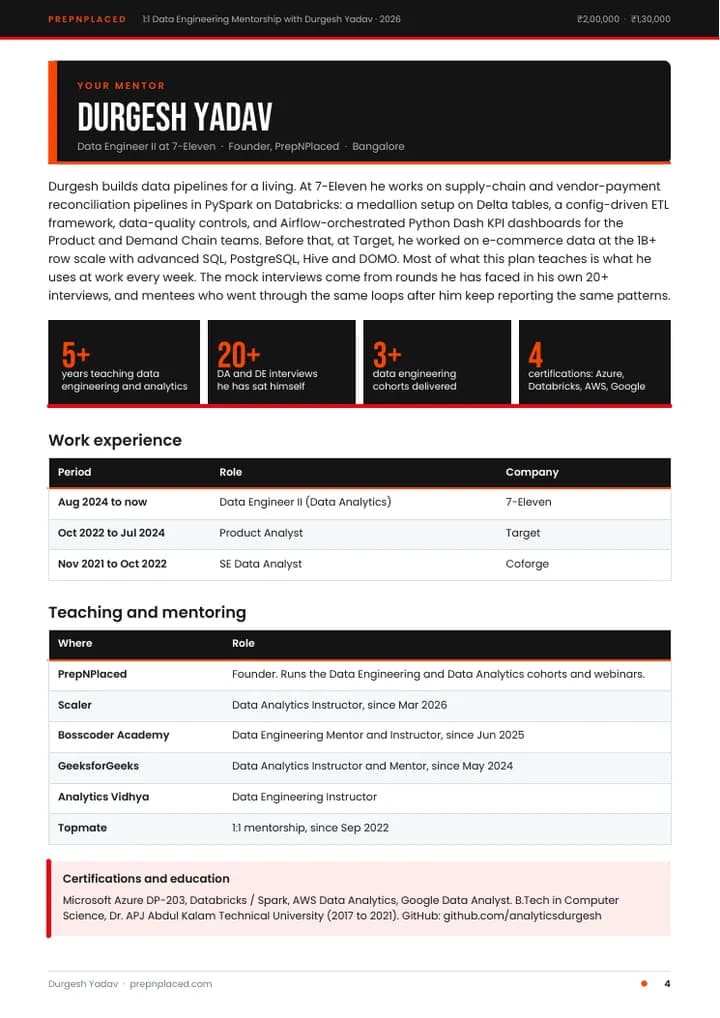
Your mentor

Durgesh Yadav
Data Engineer II at 7-Eleven · Founder, PrepNPlaced · Bangalore
4.3 on Topmate · 503 ratings
Full profileBefore you start
Book a short call with Durgesh. You pick the plan together, settle the discount if one applies, confirm your weekly slots, and your first session (M01, the skill audit) goes on the calendar.
Complete plan ₹2,00,000 · lowest ₹1,80,000
DE plan ₹1,30,000 · lowest ₹1,17,000
Good to know: This is a skills-and-proof program. It prepares you for data engineering interviews and gives you work to show for it, but it does not guarantee a placement, a salary or an interview result. Cloud usage beyond free tiers and trial credits is paid by the learner.
The plan, as a PDF
Common questions
Pick by one question: do you already know SQL and Python? The DE plan is for people who can already write joins, GROUP BY, window functions and CTEs in SQL without looking them up, and are comfortable with functions, dictionaries, file handling and basic pandas in Python. Everyone else starts with the Complete plan.
The Complete plan is ₹2,00,000 and the DE plan is ₹1,30,000. Durgesh can take up to 10% off either plan for a serious learner, decided on the intro call before you enrol, so the lowest possible fees are ₹1,80,000 and ₹1,17,000.
The SQL mock (MI01) and Python mock (MI02) run in weeks 1 and 2 of the DE plan. If a gap shows up, you add only the track you need, SQL for ₹40,000 or Python for ₹30,000, at the same hourly rates.
The Complete plan takes about 26 weeks at 3 sessions a week, or roughly 4 months at 4 to 5 a week. The DE plan takes about 15 weeks at 3 sessions a week, or roughly 10 weeks at 4 to 5 a week.
No. It prepares you for data engineering interviews and gives you work to show for it, but it does not guarantee a placement, a salary or an interview result.
Cloud usage beyond free tiers and trial credits is paid by the learner. The plan uses Databricks Free Edition, a Snowflake trial account, Docker for Kafka and Airflow, and AWS services.
Aiming for data analytics instead?
1:1 Data Analytics Mentorship
Prefer learning in a live group?
Data Engineering Cohort