Airflow Interview Questions 2026: 16 Answers That Prove You've Run Pipelines in Production
Sixteen Apache Airflow interview questions with answers that go past textbook definitions — scheduling semantics, executors, idempotency, XCom, and the TaskFlow API, explained the way a working data engineer would.
By Durgesh Yadav — Senior Data Engineer @ 7-Eleven · Updated 28 Sept 2026. Preparation guidance, not a hiring guarantee.
What are the most common Apache Airflow interview questions?
Interviewers most often ask you to explain DAGs and scheduling semantics — logical dates, data intervals, catchup versus backfill — compare operators, sensors, and hooks, justify an executor choice (Local, Celery, Kubernetes), describe XCom and its limits, and show how you make tasks idempotent and retry-safe. Freshers get definitions; experienced candidates get production-failure scenarios.
Very little of a real Airflow round is "name the operator". The interviewer is testing whether you hold the scheduler's mental model: that runs are labelled by data interval, that a daily run for Monday fires on Tuesday, and that catchup can flood a cluster on deploy. Second, production judgment — what happens when a task fails at 3 AM, whether your retry is safe to fire twice, and how you backfill a broken week without double-writing. Third, scale reasoning: which executor fits which load profile, and why a hundred poke-mode sensors is a problem. In Indian hiring the emphasis shifts with the company: services firms lean on operating and migrating existing DAGs — debugging, retries, alerting — while product companies and GCCs push design questions like idempotency, dynamic task mapping, and executor trade-offs. Experienced candidates should bring one honest war story; it outperforms any memorized list.
Scheduler mental model: data intervals, catchup, backfill
Reading about Airflow does not survive contact with a follow-up question; running it does. Stand up Airflow locally with the official Docker Compose file or the Astro CLI, then build one end-to-end DAG that mirrors a real job: pull from a public API, land raw files at interval-keyed paths, load a warehouse table, run a data-quality check. Then break it on purpose — kill a task mid-run and watch the retry, clear a task and re-run it, flip catchup on with a backdated start_date and watch the flood, then backfill a three-day window and verify nothing double-wrote. Rewrite the Python pieces with the TaskFlow API so you can compare both styles from memory. Finally, learn the templated context variables (ds, data_interval_start, run_id) until you use them without looking, and be ready to name your project's executor and defend the choice.
Rewrite it with TaskFlow; keep the operator version
Memorize the core templated context variables
Which Airflow mistakes end the round early?
The fastest self-disqualification is defining execution_date as "when the DAG runs" — it is the start of the data interval, and interviewers listen for it specifically. Close behind: treating XCom as a data pipe and proposing to pass a DataFrame between tasks, or writing tasks that compute "yesterday" from datetime.now(), which breaks on every retry and backfill. Candidates with cron-only experience often present Airflow as "cron with a UI", which signals they have never used dependencies, backfills, or trigger rules. People who have only watched the UI at work stumble on anything CLI or config: they cannot say which executor their team ran, why catchup was off, or how a task got its credentials. And almost everyone forgets that an SLA miss does not stop a task — execution_timeout does. None of these are exotic; they are the difference between having read about Airflow and having operated it.
"execution_date = run time" — the classic reject
DataFrames through XCom; now() instead of interval dates
Can't name their team's executor or catchup policy
Confusing SLA misses with execution_timeout
Why do scheduling semantics decide the round?
If one topic filters candidates, it is the scheduling model, because it cannot be bluffed. Be able to draw the timeline for a daily DAG with start_date of July 1: the first data interval spans July 1–2, so the first run fires just after midnight on July 2, carrying a logical_date of July 1. Explain what changes with catchup=True — every missed interval since start_date gets a run the moment the DAG unpauses — versus a manual backfill command scoped to a date range. Then connect it to code: every path, WHERE clause, and API window in your tasks should be driven by the data_interval_start and data_interval_end templates, which is exactly what makes retries and backfills safe. Finish with the operational edge cases: naive datetimes default to UTC (a 5:30 offset from IST), and runs execute only after their interval ends. Rehearse this as a two-minute whiteboard talk; it is the highest-leverage prep you can do.
Draw the interval timeline: start_date to first run
catchup vs backfill: automatic vs scoped-by-hand
Drive all task logic from interval templates
Timezone default is UTC; the IST offset bites
What is the difference between a sensor, a deferrable operator and a trigger rule?
A poke-mode sensor holds a worker slot for the whole wait; reschedule mode releases the slot between checks; a deferrable operator releases the slot entirely and hands the wait to the triggerer process, so a thousand waits cost one small process rather than a thousand workers. Trigger rules answer a different question: when a task may start given the state of its upstreams. The default, all_success, is why a single failed branch silently skips the cleanup task everyone assumed would run.
Sensor in poke mode: occupies a worker for the whole wait; fine for one sensor, wrong for a hundred
Sensor in reschedule mode: frees the slot between pokes; the default answer for external files and partitions
Deferrable operator: the wait lives in the triggerer, not a worker; the scale answer since Airflow 2.2
Trigger rules: all_success (default), all_done for cleanup, one_failed for alerts, none_failed_min_one_success after a branch
Worked scenario: the missed Monday run
A daily DAG with catchup=False was paused on Sunday and unpaused on Wednesday. One run is created, for the most recent complete interval; Monday's and Tuesday's intervals are never scheduled. To fill them without double-writing, the task must read {{ data_interval_start }} and {{ data_interval_end }} instead of 'today', then run a backfill for 2026-09-21 to 2026-09-23 (airflow dags backfill in Airflow 2, airflow backfill create in Airflow 3). With catchup=True the scheduler would have created those runs itself the moment the DAG was unpaused, and flooded the pool if the gap had been months.
TaskFlow API vs classic operators
@task functions pass return values through XCom automatically and read as plain Python; classic operators (BashOperator, SQLExecuteQueryOperator, sensors) exist for the work that is not Python. Mixing them is normal. The interviewer wants to hear that XCom is for small values, not for DataFrames.
Match the tool to what you are waiting on
Dimension
Sensor
Deferrable operator
Trigger rule
Question it answers
Has the outside condition happened yet
Same wait, without holding a worker
May this task start, given its upstreams
Where the wait lives
A worker slot; reschedule mode frees it between pokes
The triggerer process, as an async trigger
Nowhere; the scheduler evaluates it as upstreams finish
How you set it
Any Sensor subclass, mode poke or reschedule
deferrable=True where supported, or self.defer() in custom code
trigger_rule on any task
Default
Poke mode, holding the slot for the whole wait
Off; operators run synchronously unless asked
all_success, so one failed upstream stops the task
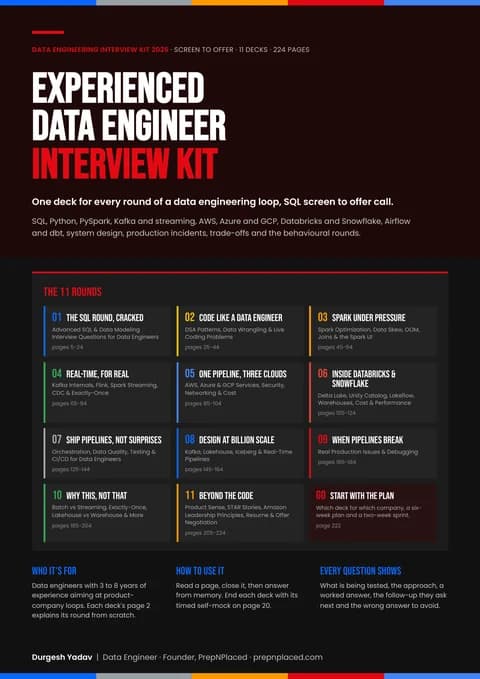
Deck 07, Ship Pipelines, Not Surprises, covers the airflow, dbt and dataops round. Writing a pipeline is half the job; running it every day without surprises is the other half. Airflow (including what changed in Airflow 3), dbt in depth, data quality, testing, code review, CI/CD and observability.
Real questions from beginner to advanced, each with a concise model answer — practice them, then rehearse live in a mock interview. Every answer is open; collapse any you have already covered.
EasyWhat is a DAG in Airflow, and how is it different from a cron job?
A DAG (Directed Acyclic Graph) is Airflow's unit of a pipeline: a set of tasks plus the dependencies between them, defined in Python, with no cycles allowed. Cron gives you time-based triggers and nothing else. A DAG adds dependency ordering (task B waits for task A), per-task retries, backfill over historical dates, data-interval awareness, parallelism controls, and a UI that shows exactly which run of which task failed and why. The acyclic constraint matters because the scheduler must resolve a topological order — a cycle would mean no valid execution order exists. A good answer also notes that DAG files are parsed repeatedly by the scheduler, so top-level code must be cheap: no API calls or database queries at module level, or you slow down scheduling for every DAG in the deployment.
EasyWhat is the difference between operators, sensors, and hooks?
An operator is a template for one unit of work — BashOperator runs a shell command, PythonOperator calls a function. When you instantiate an operator inside a DAG it becomes a task. A sensor is a special operator whose only job is to wait for a condition to become true — a file landing in S3, a partition appearing in a table, another DAG's task finishing (ExternalTaskSensor) — and only then let downstream tasks proceed. A hook is a reusable interface to an external system (Postgres, S3, an HTTP API) that manages the connection and credentials through Airflow Connections; hooks are used inside operators and sensors and are never scheduled on their own. A clean mental model to state in the interview: hooks talk to systems, operators do work, sensors wait for the world to be ready.
EasyWhat is XCom and what should it be used for?
XCom ("cross-communication") is Airflow's mechanism for passing small pieces of data between tasks. A task pushes a value — explicitly with xcom_push or implicitly by returning one — and a downstream task pulls it with xcom_pull. With the TaskFlow API this becomes invisible: return a value from one @task function, pass it as an argument to another, and Airflow wires the XCom for you. Values are serialized and stored in the metadata database, keyed by DAG id, task id, and run. That storage location is the key constraint: XCom is for metadata — a row count, a filename, an S3 key — not for datasets. Passing a DataFrame through XCom bloats the metadata database and pressures the scheduler; pass a path or table name and let the downstream task fetch the data itself.
EasyHow do task retries work in Airflow?
Every task can declare retries (attempts after the first failure), retry_delay (wait between attempts), and optionally retry_exponential_backoff with max_retry_delay so waits grow instead of hammering a struggling service. These are usually set in default_args at the DAG level and overridden per task. When an attempt fails, the task moves to up_for_retry until attempts run out, then becomes failed, and that failure propagates downstream according to each task's trigger rule. Two related settings interviewers like: execution_timeout, which kills an attempt that runs too long — a retry cannot fire until the hung attempt actually ends — and callbacks such as on_retry_callback and on_failure_callback for alerting. The catch worth stating: retries only help if the task is idempotent. Retrying a non-idempotent append can double-write data, which turns a transient failure into silent corruption.
EasyWhat are the main components of Airflow's architecture?
Five core pieces. The scheduler parses DAG files, creates DAG runs when their schedule is due, and hands ready tasks to the executor. The executor decides where task work runs — local subprocesses, Celery workers, or Kubernetes pods. Workers execute the task code (with LocalExecutor the scheduler's machine plays this role). The webserver serves the UI for monitoring, triggering, and clearing tasks. The metadata database — usually Postgres or MySQL — stores all state: DAG runs, task instances, XComs, connections, variables. Since Airflow 2.2 there is also the triggerer, a process running the async event loop for deferrable operators, letting thousands of waiting tasks park without occupying worker slots. Knowing which component owns which failure mode — UI up but nothing running usually means a scheduler problem — is what interviewers actually probe.
MediumWhat is the difference between catchup and backfill?
Both create runs for past data intervals; the difference is who initiates. With catchup=True, the scheduler automatically creates a run for every interval between start_date and now that has not run yet — deploy a daily DAG with a start_date six months back and roughly 180 runs queue instantly. Backfill is explicit and on-demand: airflow dags backfill -s 2026-06-01 -e 2026-06-07 my_dag creates or re-runs runs only for that range, regardless of the catchup setting. In practice most teams set catchup=False so deploys and un-pauses do not flood the cluster, then run targeted backfills when they genuinely need history. A strong answer names the guardrails: max_active_runs to cap concurrency during the backfill, depends_on_past when intervals must process in order, and idempotent tasks so re-running a range is safe.
MediumWhy does a daily DAG run for Monday actually execute on Tuesday?
Because Airflow schedules by data intervals, not wall-clock trigger times. A daily run "for" 2026-07-21 covers the interval from 2026-07-21 00:00 to 2026-07-22 00:00, and it only starts after that interval ends — only then is Monday's data complete. The run's logical_date (historically execution_date, now a deprecated alias) is the start of that interval, not the moment of execution. This is the single most common Airflow misunderstanding, so interviewers use it as a filter question. Practical implications: templates like ds, data_interval_start, and data_interval_end should drive all date logic in your tasks; the first run of a new DAG happens one full interval after start_date; and code that uses datetime.now() instead of the interval breaks the moment you retry or backfill. If you can whiteboard the interval timeline, you clear this question.
MediumHow do you make an Airflow task idempotent, and why does it matter?
An idempotent task produces the same end state no matter how many times it runs for the same data interval. It matters because Airflow's whole value — retries, backfills, clearing failed tasks — assumes re-running is safe. Techniques: key every read and write to the templated interval (write to a path like s3://bucket/table/ds=2026-07-21/); prefer overwrite semantics — delete-then-insert for the partition, or MERGE/upsert — over blind appends; never derive dates from datetime.now(); make DDL steps use IF NOT EXISTS; and guard side effects like emails or API posts with state checks. Classic non-idempotent bug: a task that appends "yesterday's" rows computed from the current clock — retry it a day late and it loads the wrong window, twice. Interviewers often show exactly that snippet and ask you to spot the problem.
MediumCompare the Local, Celery, and Kubernetes executors. When would you pick each?
The executor defines where task processes run. SequentialExecutor runs one task at a time against SQLite — demos only. LocalExecutor runs tasks as parallel subprocesses on the scheduler's machine: the simplest production setup, fine until one box cannot hold your concurrency or you need isolation. CeleryExecutor distributes tasks to a static worker fleet through a message broker (Redis or RabbitMQ): good steady-state throughput and fast task start, but you run always-on workers and every worker needs all DAG dependencies installed. KubernetesExecutor launches a fresh pod per task: strong isolation, per-task resource requests and images, scale-to-zero — at the cost of pod start-up latency and Kubernetes operational overhead. Rule of thumb: single team with modest load, LocalExecutor; high sustained volume of short tasks, Celery; spiky load or conflicting dependencies across teams, Kubernetes.
MediumWhat does the TaskFlow API change compared to classic operators?
The TaskFlow API (Airflow 2.0+) lets you define tasks as plain Python functions with the @task decorator and DAGs with @dag. Its main win is data passing: return a value from one task, pass it as an argument to the next, and Airflow creates the XComs and the dependency edge automatically — no xcom_pull with string task ids, no PythonOperator boilerplate with python_callable and op_kwargs. DAG code reads like normal Python, which kills the classic bug class of misspelled task-id strings. Two limits worth stating: values passed this way still travel through XCom, so the small-data rule still applies; and TaskFlow covers Python work — for transfer or vendor operators (S3, BigQuery, Spark submit) you still instantiate classic operators. Mixing both styles in one DAG is fully supported and is what real codebases do.
MediumExplain sensor poke mode vs reschedule mode vs deferrable operators.
In poke mode a sensor occupies a worker slot for its entire wait, sleeping between checks — a hundred sensors waiting on files burn a hundred slots doing nothing. In reschedule mode the sensor releases its slot between checks: it enters up_for_reschedule and the scheduler re-queues it at the next poke interval, so slots are held only during the actual check. Deferrable operators (Airflow 2.2+) go further: the task defers to a trigger — an async coroutine run by the triggerer process — so thousands of waits share one event loop at near-zero worker cost; when the event fires, the task resumes on a worker. Rule of thumb: short waits with tight polling, poke; long waits with coarse polling, reschedule; large-scale or very long waits where slot economics matter, deferrable. Naming the triggerer by name signals real 2.x experience.
MediumHow do SLAs work in Airflow, and what are the gotchas?
An SLA in Airflow 2.x is a timedelta on a task: if the task has not completed within that window measured from when the DAG run starts, the scheduler records an SLA miss, surfaces it in the UI, and can send an email or invoke the sla_miss_callback. The gotchas are what interviewers actually want. SLA misses are only evaluated for scheduled runs — manually triggered runs skip them entirely. An SLA miss does not stop or fail the task; a hard cap is execution_timeout, which kills the attempt. The callback is defined at the DAG level, not per task, and receives misses in batches. Because of these rough edges, many teams implement latency alerting outside Airflow instead, and SLA handling has been reworked in newer Airflow releases — saying that out loud signals real-world experience rather than doc-reading.
HardWhat is dynamic task mapping, and how does it differ from generating DAGs dynamically?
Dynamic task mapping (Airflow 2.3+) creates a variable number of parallel task instances at runtime from data an upstream task produced. You call .expand() with the varying argument — often a prior task's output — and .partial() for constants: process.partial(table="events").expand(file=list_files_output). Each mapped instance is scheduled, retried, and logged independently, and the Grid view shows them individually. Contrast that with dynamic DAG generation, where a parse-time Python loop stamps out tasks: that shape is frozen when the file is parsed and cannot react to "how many files landed today". Constraints worth naming: the mapped input travels through XCom, so map over lists of keys or paths, never payloads; there is a configurable cap on mapped instances (max_map_length); and you can bound the fan-out's parallelism with max_active_tis_per_dag so five hundred mapped copies do not starve the rest of the cluster.
HardHow would you design a pipeline so a week-long backfill is safe?
Start with the contract: any interval can be re-run at any time, alone or in bulk, and produce correct results. Concretely: every task derives its window strictly from data_interval_start and data_interval_end templates — zero datetime.now(); writes are partition-scoped overwrites or MERGEs so a re-run replaces rather than duplicates; intermediate artifacts live at deterministic, interval-keyed paths. Then control the blast radius of the backfill itself: cap max_active_runs so queued runs do not starve everything else; use pools to protect a rate-limited source API; set depends_on_past only if intervals genuinely depend on prior state, because it serializes the whole backfill. Call out the semantic trap: today's DAG code runs against historical intervals, so if business logic changed mid-year, a naive backfill silently rewrites history under new rules. Finally, rehearse on a two-day range and verify counts before running the real thing.
HardXCom is too small for your data. What are your options at scale?
Default XCom serializes values into the metadata database, which caps practical size at what your DB tolerates and, worse, puts data volume on the component every scheduler query touches. Three escape hatches. First, pass references by convention — S3 keys, table names, run ids — and let downstream tasks fetch the data themselves; this is the most common production pattern. Second, implement a custom XCom backend: subclass BaseXCom and override its serialize/deserialize hooks so large values are transparently written to object storage with only a reference stored in the database — task code stays unchanged, which is the selling point. Third, restructure so the handoff is the storage layer itself: task A writes a partition, task B reads that partition, and nothing crosses XCom but the partition key. Interviewers want you to reject "just XCom the DataFrame" and articulate exactly why it fails.
HardA DAG did not run when you expected. Walk through your debugging process.
Walk it as an ordered checklist, most likely first. Is the DAG paused? New DAGs deploy paused by default unless configured otherwise. Does it parse? An import error keeps it out of scheduling entirely — check the UI banner or airflow dags list-import-errors. Then scheduling semantics: the first run fires only after the first full data interval ends, so start_date of today with a daily schedule produces nothing until tomorrow; and with catchup=False you only get intervals after the DAG appears. Timezone next: a naive start_date is treated as UTC, so a "9 AM" expectation in IST drifts by 5:30. Then capacity: is a stuck previous run holding max_active_runs, or is the pool exhausted? Finally the platform itself: is the scheduler alive and heartbeating, and did the new DAG file actually reach every component? Naming even four of these, in order, reads as production experience.
By company
Analytics Engineer interviews that ask these questions
See how this topic shows up in real Analytics Engineer loops — rounds, difficulty and company-specific questions:
Is Airflow required for data engineering jobs in India?
Not universally, but it is the most commonly listed orchestrator in Indian data engineering JDs across services companies, GCCs, and product startups, so it is the safest one to prepare. Even teams running Dagster, Prefect, or a managed scheduler test the same concepts — dependencies, idempotency, backfills — through whatever tool they use. If a JD says "any orchestration tool", well-prepared Airflow answers transfer almost one-to-one.
Should I prepare Airflow 2.x or Airflow 3 in 2026?
Prepare 2.x semantics first: TaskFlow, data intervals, executors, and deferrable operators are what most production estates still run and what interviews actually probe. Airflow 3 has shipped, but migrations are gradual, and its core concepts build directly on 2.x — logical dates, DAG authoring, and the scheduler model carry over. Mentioning that you track 3.x changes is a bonus; fumbling 2.x fundamentals while name-dropping 3.x is not.
How much Airflow do freshers actually get asked?
Freshers typically get definitions with one filter question: what a DAG is, operators versus sensors, how retries work, what XCom is for — plus the scheduling-semantics question that separates readers from users. You are rarely expected to have scale war stories, but you are expected to have run Airflow locally. One self-built DAG you can defend — why these retries, why catchup is off — puts you ahead of most fresher candidates.
I have only used managed Airflow (MWAA or Cloud Composer). Is that a problem?
No — managed services change who patches the scheduler, not how DAGs behave. Scheduling semantics, idempotency, XCom, sensors, and TaskFlow are identical. Close two gaps, though: know which executor your managed service ran underneath, and be ready for "how would you self-host this" questions covering workers, the metadata database, and the triggerer, because interviewers use them to check depth beyond the cloud console.
What should I prepare alongside Airflow?
Airflow alone rarely clears a data engineering round. Pair it with strong SQL (window functions, incremental loads), solid Python, and one processing layer — Spark or dbt — because most Airflow questions are really pipeline-design questions wearing Airflow vocabulary. If the role touches cloud, know how your DAGs authenticated to object storage and the warehouse via Airflow Connections. One end-to-end pipeline you can narrate covers more interview surface than five half-known tools.
Next Step
Turn The Guide Into Practice
Use PrepNPlaced tools to turn this learning path into resume proof, targeted practice, and interview-ready explanations.