New · 11 decks · 224 pages · PDF
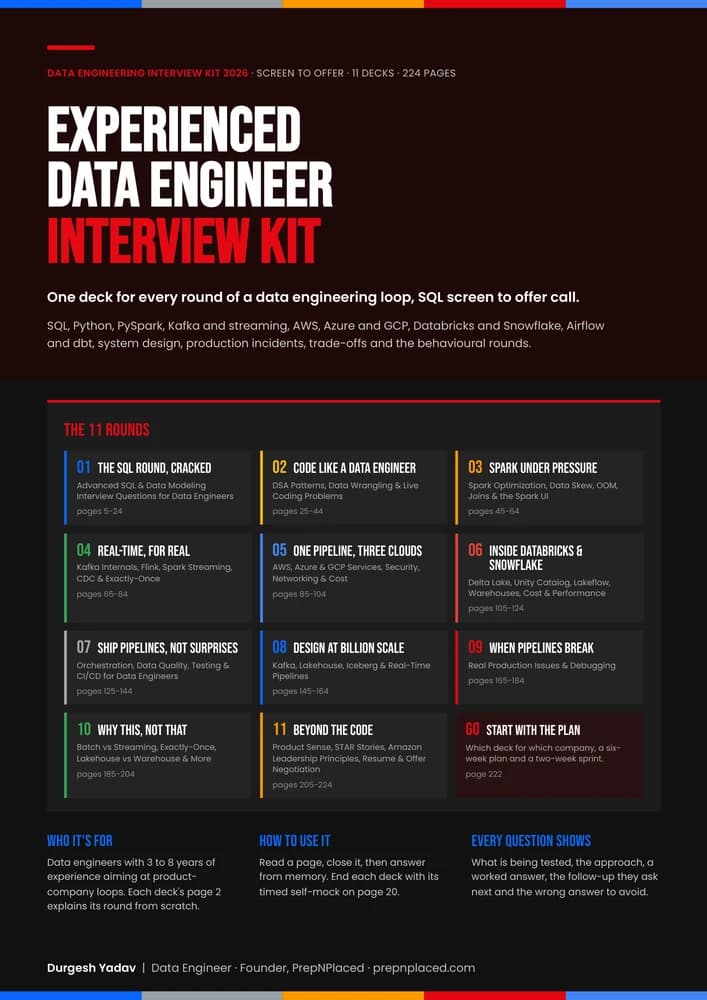
Experienced Data Engineering Interview Kit 2026One deck for every round of a data engineering loop, SQL screen to offer call.
SQL, Python, PySpark, Kafka and streaming, AWS, Azure and GCP, Databricks and Snowflake, Airflow and dbt, system design, production incidents, trade-offs and the behavioural rounds. Each deck shows how its round runs and is graded, then works the questions interviewers ask most.
By Durgesh Yadav · Founder · Senior Data Engineer @ 7-Eleven · October 2026
₹499
One payment. PDF, yours to download again any time.
Included free for learners in the AI-Powered Data Engineering cohort and in 1:1 mentorship: sign in with the email you enrolled with.
Reviewed before launch. About 1,650 technical claims and 215 code blocks checked; every error found is fixed in this edition.
- decks, one for each round of a data engineering loop
- 11decks, one for each round of a data engineering loop
- parts to every question: what is tested, approach, answer, follow-up, wrong answer
- 5parts to every question: what is tested, approach, answer, follow-up, wrong answer
- timed self-mocks with a rubric, one at the end of each deck
- 11timed self-mocks with a rubric, one at the end of each deck
- week plan, a two-week sprint and a full mock loop for the whole kit
- 6week plan, a two-week sprint and a full mock loop for the whole kit
What's inside
Eleven decks, one for every round
Each deck is 20 pages: page 2 explains how the round runs and how it is graded, the middle pages work the questions, and the last two are rapid-fire answers and a timed self-mock with a rubric.
Deck 01pages 5-24
The SQL Round, Cracked
SQL and modeling
The round that ends most loops early. Eight query patterns that cover most SQL questions, three modeling cases worked from grain to final query, and a timed self-mock.
- Window functions and frames in one page
- Top-N, dedup, sessionization, gaps and islands
- Retention, cohorts and funnels
- Facts, dimensions and SCD Type 2
- Late data, MERGE and joins that lie
- 3 modeling cases: streaming, delivery, retail
PostgreSQLSnowflakeBigQueryDatabricksSpark SQLTrino
Deck 02pages 25-44
Code Like a Data Engineer
Python coding
The Python round in a DE loop is practical: parse it, count it, join it, order it, without running out of memory. The patterns behind most questions, Big-O in plain words, pandas vs PySpark vs pure Python, and worked problems.
- Big-O in plain words, with the hidden costs
- Parsing, hashing and reconciliation
- Sorting, intervals, windows, two pointers
- Heaps, top-K and k-way merge
- Nested JSON, generators and big files
- LRU cache, rate limiter, mini pipeline
PythonpandasNumPyPolarsDuckDBpytest
Deck 03pages 45-64
Spark Under Pressure
PySpark
Interviewers now care less about which config you'd set and more about how you diagnose a slow or failing job. The Spark UI, OOMs, skew, joins, AQE and the small-file problem, plus 8 live coding problems.
- Architecture, lazy evaluation, the shuffle
- OOM with enough resources: 6 causes
- Data skew and the 45-minute task
- Join strategies and AQE
- Reading the Spark UI
- 8 live coding problems
Apache SparkDatabricksPySparkParquetpandas UDFsKafka source
Deck 04pages 65-84
Real-Time, for Real
Kafka and streaming
Streaming rounds go past "use Kafka". What happens when a broker dies, why consumers keep rebalancing, why a watermark won't advance, and how to get exactly-once results. Then three real-time designs.
- Kafka architecture, KRaft and durability
- Producers, consumers and rebalancing
- Event time, windows and watermarks
- Exactly-once and CDC with Debezium
- Flink: state, checkpoints, windows, joins
- Spark Structured Streaming in depth
KafkaFlinkSparkDruidClickHouseRedis
Deck 05pages 85-104
One Pipeline, Three Clouds
AWS, Azure and GCP
Learn one cloud deeply and map the other two. The service map across AWS, Azure and Google Cloud, the questions each stack is known for, the security, networking and cost problems that break real jobs, and migrations.
- Service map: one job, three clouds
- AWS: Glue, EMR, Athena, Redshift, Kinesis
- Azure: ADF, Synapse, Event Hubs, Fabric
- Google Cloud: BigQuery, Dataflow, Pub/Sub
- Identity, secrets and networking
- Cost, IaC, migrations, 12 scenarios
AWSMicrosoft AzureGoogle CloudBigQueryDatabricksTerraform
Deck 06pages 105-124
Inside Databricks & Snowflake
Databricks and Snowflake
Most Indian product and services teams run on one of these two platforms, and their interviews go deep on it. How each works inside, how to load and model data on it, how to secure it, and how to keep the bill under control.
- Databricks architecture, compute and DBUs
- Delta Lake internals and layout
- Auto Loader, Lakeflow pipelines and Jobs
- Snowflake architecture and micro-partitions
- Snowpipe, streams, tasks, dynamic tables
- Databricks vs Snowflake
DatabricksSnowflakeApache SparkMLflowParquetSnowpark
Deck 07pages 125-144
Ship Pipelines, Not Surprises
Airflow, dbt and DataOps
Writing a pipeline is half the job; running it every day without surprises is the other half. Airflow (including what changed in Airflow 3), dbt in depth, data quality, testing, code review, CI/CD and observability.
- Airflow architecture and Airflow 3 changes
- Scheduling: intervals, catchup, backfills
- dbt: models, incremental, microbatch
- Tests, unit tests and contracts
- CI/CD, containers, observability
- 12 DataOps scenarios
AirflowdbtGitGitHub ActionsDockerpytest
Deck 08pages 145-164
Design at Billion Scale
System design
The round that usually decides your level. One 6-step method for every prompt, the building blocks and when to use each, and six designs worked end to end, starting with a platform for billions of playback events a day.
- Requirements and back-of-envelope numbers
- Building blocks map: what to use when
- Design 1: playback events at billions a day
- Designs 2 to 6: fraud, CDC, KPIs, ads, LLM data
- Idempotency and exactly-once, end to end
- Late data and safe backfills
KafkaFlinkSparkApache IcebergDruidAirflow
Deck 09pages 165-184
When Pipelines Break
Scenario questions
Senior interviews test whether you've run pipelines, not just built them. Fifteen incident pages across Kafka, Spark, Airflow, warehouses, table formats, streaming and PII, each with a debug order, the fix, and the check that would have caught it.
- The 5-step debug order interviewers grade
- Kafka lag, duplicates, poison messages
- Spark: slower with no code change
- Green pipeline, wrong numbers
- Backfills and schema changes gone wrong
- PII and deletion requests
KafkaSparkAirflowDatabricksSnowflakeGrafana
Deck 10pages 185-204
Why This, Not That
Trade-offs
Senior answers are graded on judgement. One answer shape for every "why X and not Y" question, applied to the 16 trade-offs interviewers ask most, each with the deciding factor, the cost, and what would change your mind.
- The answer shape interviewers grade
- Kafka vs batch, streaming vs batch
- Exactly-once vs at-least-once
- Warehouse vs lakehouse vs OLAP, ETL vs ELT
- Central platform vs data mesh
- 15 X-or-Y answers
KafkaSparkSnowflakeDatabricksFlinkApache Iceberg
Deck 11pages 205-224
Beyond the Code
Behavioural and offer
Strong engineers still lose offers here. Product sense and metrics, behavioural and leadership principles, the project deep dive and the hiring manager. Then the resume, the recruiter screen and the offer, plus the plan and full mock loop for the whole kit.
- Product sense: metrics for a feature
- STAR stories and the story bank
- Amazon Leadership Principles for DEs
- Project deep dive; hiring manager round
- Resume, recruiter screen, offer
- Six-week plan and full mock loop
AmazonMetaGoogleNetflixIndian product companies
How a question page works
Every question shows five things
Interviewers grade the shape of an answer as much as the facts in it. So each question is laid out the way a strong candidate would answer it, with the trap next to it.
- 1TestingWhat the interviewer is actually checking with the question.
- 2ApproachHow to open the answer, before any detail.
- 3AnswerA worked answer, with the SQL, Python or config where it matters.
- 4Follow-upThe question they ask next, and how to take it.
- 5Wrong answerThe answer that sounds fine and loses the round.
Free sample
Read 20 of the 224 pages free
The cover, the contents and one page from every deck:
- p1 The kit cover
- p2 Contents: decks 01 to 04
- p3 Contents: decks 05 to 08
- p4 Contents: decks 09 to 11
- p6 How the SQL round runs
- p7 Window functions in one page
- p8 Top-N per group
- p27 Big-O in plain words
- p46 How the Spark round runs
- p52 Data skew
- p73 Exactly-once in Kafka
- p87 Service map: one job, three clouds
- p107 Databricks architecture and compute
- p128 Airflow scheduling: intervals and catchup
- p147 System design: requirements and numbers
- p166 How scenario questions are graded
- p169 Spark job 3× slower, same code
- p187 Kafka vs batch ingestion
- p213 STAR stories and the story bank
- p222 Which deck, when: the six-week plan
Checking your access to the book…
Who it's for
Built for experienced data engineers
- You have 3 to 8 years in data and are preparing for product-company loops
- You want the questions asked now: Airflow 3, Iceberg and Delta, Lakeflow, dbt unit tests and contracts
- You have 2 years and want to aim higher: each deck's page 2 explains its round from scratch
- You have a loop in two weeks: Deck 11 has a two-week sprint as well as the six-week plan
- You are a student or fresher starting from zero. Start with the free book
- You are moving into data engineering from another career. Read the playbook first
How to use it
- 1. Start with the plan. Deck 11, page 18 says which deck to read for which company, with a six-week plan and a two-week sprint.
- 2. Read a page, close it, answer from memory. Out loud or on paper. Recall is what the round tests.
- 3. End each deck with its self-mock. Page 20 of every deck is timed and has a rubric. Ask a friend to play the interviewer.
- 4. Run the full loop. Deck 11, page 19 strings the self-mocks into one mock loop. Score it and reread only the pages behind your lowest score.
Checked before launch
Reviewed claim by claim
Before the kit went on sale every deck was checked claim by claim: about 1,650 technical claims and 215 code blocks. The review found 25 errors, among them Airflow 3 scheduling, Kafka sink guarantees, Delta and Iceberg deletes, PySpark storage levels and a Kafka consumer loop. All 25 are corrected in this edition.
Interview content goes out of date fast. If you find something wrong, email support@prepnplaced.com with the deck and page. Corrections go into the copy every buyer downloads from this page.
Questions
Before you buy
Who is the kit for?
Data engineers with 3 to 8 years of experience preparing for product-company loops. Each deck's page 2 explains how its round runs and is graded from scratch, so a candidate with 2 years can follow it too.
What exactly do I get?
One 224-page PDF: the kit cover, three contents pages where every page title is a link, and 11 decks of 20 pages, one per interview round. Each deck ends with rapid-fire answers and a timed self-mock with a rubric.
Can I read some of it before buying?
Yes. Sign in with Google and read 20 pages free: the cover, the contents and one page from every deck.
How accurate is it?
Every deck was reviewed claim by claim before launch: about 1,650 claims and 215 code blocks checked. The 25 errors found, including Airflow 3 scheduling, Kafka sink guarantees, Delta and Iceberg deletes, PySpark storage levels and a Kafka consumer loop, are corrected in this edition. Found another? Email support@prepnplaced.com with the deck and page.
Is it part of the notes vault or the Learn Pass?
No. Like the system design book and the career transition playbook, it is sold on its own for ₹499. It is included free for Data Engineering cohort learners and 1:1 mentorship learners.
How do I get the PDF after paying?
Pay once on this page and the download button appears straight away. The PDF is yours to download again any time from this page, signed in with the same Google account. Each copy carries your email in the footer.
Can I get a refund?
Refunds are handled under our Refund Policy. If something is wrong with your copy, email support@prepnplaced.com from the address you paid with and include your order id.
Does it promise a job or an offer?
No. It prepares you for the rounds. Interviews, offers and pay depend on you, the market and the company.