Behavioral Interview Questions & the STAR Method: Sample Answers (2026)
Behavioral interviews reward real stories, not rehearsed clichés. Learn the STAR method step by step, then borrow worked sample answers for conflict, failure, leadership, and deadline questions — built for Indian freshers, experienced pros, and career-switchers.
By Durgesh Yadav — Senior Data Engineer @ 7-Eleven · Updated 25 Jul 2026. Preparation guidance, not a hiring guarantee.
Use the STAR method: describe the Situation and your Task, then the specific Actions you took and the measurable Result. Pick a real story that matches the question's theme, keep the focus on what you personally did, and end with a clear outcome or lesson. Practice out loud so it stays under two minutes.
Behavioral questions all rest on one belief: the best predictor of future behaviour is past behaviour. When an interviewer asks "Tell me about a time you...", they are not collecting a story for entertainment — they are checking whether you have actually done the thing the role needs, or are only claiming you can. A hiring manager at a services company, a GCC, or a product startup is quietly scoring four things: can you own a problem, can you work with people who disagree with you, can you make decisions when information is incomplete, and do you learn from what goes wrong. Freshers are assessed on potential and self-awareness; experienced candidates on judgement and impact; career-switchers on transferable evidence. The subtext of every prompt is "show me proof, not adjectives." Anyone can say they are a team player or good under pressure. The candidate who wins is the one who says exactly what happened, what they personally did, and how it turned out — with enough specifics that it clearly could not have been invented.
Past behaviour is treated as the best predictor of future performance
They score ownership, collaboration, judgement under ambiguity, and learning
Specifics prove the story is real; adjectives prove nothing
Freshers show potential; experienced show impact; switchers show transfer
How does the STAR method work in practice?
STAR is the spine of every strong behavioral answer: Situation, Task, Action, Result. Situation sets the scene in one or two sentences — where you were, when, and what was at stake. Keep it short; context is not the point. Task states your specific responsibility: what were you accountable for, not the team in general. Action is the heart of the answer and should take roughly 60% of your airtime — the concrete steps you took, the trade-offs you weighed, the way you handled people. Use "I" more than "we," because the interviewer is hiring you, not your old team. Result closes with the outcome, ideally something you can quantify — time saved, a bug fixed, a client retained, a deadline met — plus a one-line lesson if the story ended imperfectly. A clean STAR answer runs 90 seconds to two minutes. Before the interview, write five stories in STAR form that between them cover conflict, failure, leadership, ambiguity, and a proud win; most behavioral prompts are just different doors into the same five stories.
Situation + Task: 2-3 sentences of context, no more
Action: about 60% of the answer, told in 'I' not 'we'
Result: quantify the outcome, add a lesson if it went sideways
Prep 5 flexible stories: conflict, failure, leadership, ambiguity, a win
What do worked STAR answers for three profiles look like?
Take one prompt — "tell me about a time you handled a conflict" — and watch how three profiles answer it honestly. Fresher: "In my final-year project, our team split over building the model in Python or R. As the person integrating everyone's code, I had to pick a stack fast. I set up a 30-minute call, listed our real constraints — the college GPU only had Python set up and two teammates didn't know R — and proposed Python with a shared style guide. We aligned that day and submitted two days early." Experienced: "A client wanted a three-week feature in one week. I walked the account manager through the risk list and proposed shipping a working core first, the rest a fortnight later. They agreed, we hit both dates, and the account renewed." Career-switcher: draw from your old field — "As a teacher, I mediated between two parents with opposite demands by finding the shared goal, the child's progress." Same STAR spine, different raw material — the structure travels across every background.
Fresher: pull stories from projects, internships, fests, or group assignments
Experienced: lead with business impact — deadlines hit, clients kept, costs cut
Career-switcher: reframe old-field wins as transferable STAR evidence
One good story can answer several prompts if you shift the emphasis
Why do behavioral answers fall flat?
The most common failure is telling the story in "we" — the interviewer finishes with no idea what you actually did. Fix it by narrating your specific actions in the first person, even on a team win. The second is rambling: candidates spend 90 seconds on the Situation and 10 on the Result, so the point never lands. Front-load context, then get to your actions and the outcome. Third, vague results — "it went well," "everyone was happy." Reach for a number or a concrete change: two days early, zero production bugs, the client renewed. Fourth, picking a fake or trivial conflict to look agreeable; interviewers can tell, and it wastes your best evidence. Fifth, throwing a real teammate or manager under the bus — blame reads as poor judgement, so describe the disagreement neutrally and focus on how you resolved it. Finally, no lesson on failure questions: if the story ended badly, the recovery and what you changed afterwards is the entire point. Answer honestly; a real, imperfect story beats a polished fake one every time.
Telling it in 'we' — the interviewer never learns what you did
Burying the result; quantify the outcome instead of 'it went well'
Blaming a teammate or manager — resolve neutrally, never trash people
Skipping the lesson on failure questions — the recovery is the point
What do behavioral rounds ask career switchers?
Expect the usual STAR stories plus questions about the move itself: what you owned in your last role and what you only contributed to, whether you have worked on production pipelines, and whether you would take a level below your current one. Answer ownership questions at the level you had, because the follow-ups check it. The Data Engineering Career Transition Playbook (Chapter 11) lists ten of these questions and how to prepare each.
For the behavioural and offer rounds
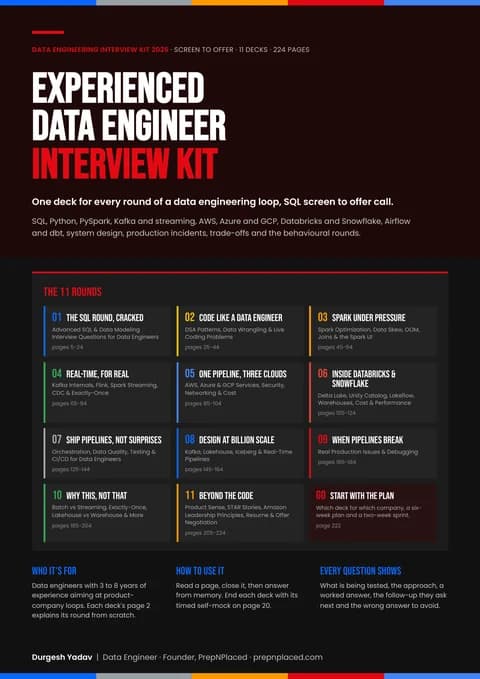
Experienced Data Engineering Interview Kit 2026
Deck 11, Beyond the Code, covers the behavioural and offer round. Strong engineers still lose offers here. Product sense and metrics, behavioural and leadership principles, the project deep dive and the hiring manager. Then the resume, the recruiter screen and the offer, plus the plan and full mock loop for the whole kit.
Real questions from beginner to advanced, each with a concise model answer — practice them, then rehearse live in a mock interview. Every answer is open; collapse any you have already covered.
EasyTell me about a time you worked effectively in a team.
In my final semester, four of us built a sales-analytics dashboard as our capstone (Situation). I owned the data-cleaning pipeline and integration (Task). Early on, progress stalled because everyone worked in isolation, so I set up a shared Git repo, a 15-minute daily stand-up, and a simple task board (Action). We caught integration bugs days earlier and submitted a working demo two days before the deadline; our guide rated it the best in the batch (Result). I learned that a team performs best when coordination is visible, not assumed — a habit I've kept in every group project since.
EasyDescribe a time you had to meet a tight deadline.
During my internship at a services firm, a client asked for a demo report two days earlier than planned (Situation). I was responsible for the analysis and slides (Task). I listed what was truly essential, dropped two nice-to-have charts, blocked focused time by silencing Slack in the mornings, and asked a senior for a 20-minute review midway to catch errors early (Action). I delivered the report a few hours before the new deadline, and the client approved it without changes (Result). The lesson stuck: under time pressure, ruthlessly separating essential from nice-to-have is what saves you, not simply working longer hours.
EasyTell me about a time you helped a colleague or teammate.
A teammate on my project was struggling with a Python module the rest of us knew well, and I could see he was too hesitant to ask (Situation). With our submission a week away, I didn't want him blocked (Task). I offered a quiet 30-minute pair session, walked through the logic with a small example, and shared a couple of reference links he could revisit (Action). He finished his part on time and later helped debug my code in return (Result). It reminded me that helping a teammate early is rarely lost time — it usually comes back, and it makes the whole team faster.
EasyGive an example of a goal you set and achieved.
In my pre-final year I set a goal to get placement-ready in data analytics within four months (Situation/Task). I broke it into weekly targets — SQL and Python basics first, then two portfolio projects, then mock interviews (Action). I tracked progress in a simple sheet and adjusted when I fell behind on SQL by adding extra practice sets. By the deadline I had two projects on GitHub and had cleared three mock rounds (Result). The habit of turning a big goal into weekly, checkable steps is something I now apply to any large task, at work or outside it.
EasyTell me about a time you had to learn something new quickly.
Two weeks into my internship, my mentor moved teams and I inherited a dashboard built in a BI tool I'd never used (Situation). I had to keep it running and add a requested filter (Task). I spent the first evening on the official tutorial, rebuilt one existing chart from scratch to understand the data model, and kept a running list of questions for a quick call with a senior (Action). Within three days I shipped the new filter, and it worked correctly on the first review (Result). I learned that the fastest way to learn a tool is to rebuild something that already works, not to read passively.
MediumTell me about a time you had a conflict with a coworker.
On a delivery project, a fellow developer and I disagreed on whether to refactor a messy module now or after the release (Situation). We were both responsible for that component and the tension was slowing us down (Task). Instead of arguing over Slack, I asked for a short call, laid out the release risk of a big refactor, and listened to his point that the mess would cost us later (Action). We compromised: a minimal safe cleanup now, full refactor logged for the next sprint. We shipped on time and did the refactor two weeks later (Result). I learned to attack the problem on a shared whiteboard, not the person — most 'conflicts' are just two people optimising for different things.
MediumTell me about a time you failed.
In my first internship I owned a small automation script and assumed my local tests were enough, so I skipped writing a proper test case (Situation/Task). When it ran on real data it mis-handled an edge case and produced a wrong summary that a senior caught before the client saw it (the failure). I owned the mistake immediately, fixed the logic, added tests for edge cases, and wrote a short note so the team wouldn't repeat it (Action/Result). Nothing reached the client, but it was a genuine miss. The lesson — never trust code on real data until it's tested against messy inputs — has saved me several times since. I'd rather share a real failure than a fake weakness.
MediumTell me about a time you showed leadership.
During a college hackathon our five-person team lost two hours arguing over scope and had nothing built (Situation). Though no one had named a lead, I stepped in (Task). I proposed we cut to one core feature we could actually demo, split the work by strength — two on backend, two on UI, me on integration and the pitch — and set 90-minute checkpoints (Action). We had a working prototype with an hour to spare and placed in the top five (Result). I didn't have a title; leadership here just meant creating clarity when the team was stuck. That's the kind of initiative I'd bring even in a junior role.
MediumDescribe a time you had to work with unclear or ambiguous requirements.
A client request came in as one line: 'make the report more useful' (Situation). As the analyst, I had to turn that into something concrete (Task). Rather than guess and rebuild blindly, I drafted three quick mock versions with different emphases — a trend view, a comparison view, and an alerts view — and shared them with the account manager to react to (Action). The client immediately pointed at the alerts view, and I built that. It saved days of rework and they said it was exactly what they'd meant (Result). I learned that with ambiguity, showing options fast beats waiting for perfect clarity — a rough draft turns a vague ask into a real decision.
MediumTell me about a time you received critical feedback.
In a review, my manager told me my status updates were too long and buried the important points (Situation). My instinct was to feel defensive, but the feedback was fair (Task). I asked for a specific example, and saw she was right — my updates read like logs, not summaries (Action). I switched to a three-line format: what's done, what's blocked, what I need. Within a couple of weeks she said the updates were much easier to act on, and a teammate adopted the same format (Result). I've come to treat critical feedback as free coaching — the discomfort lasts a minute, but the improvement is permanent.
MediumTell me about a time you had to convince someone to see things your way.
I believed we should automate a weekly manual report, but my team lead worried the setup time wasn't worth it (Situation/Task). Rather than push my opinion, I timed the manual task for two weeks — it was about three hours a week — and built a small proof-of-concept in an afternoon to show it was feasible (Action). I presented the numbers: roughly 150 hours a year saved against half a day of setup. Seeing the concrete trade-off, he agreed, and we rolled it out (Result). I learned persuasion at work runs on evidence, not eloquence — a small working demo convinces more than any argument.
MediumTell me about a time you had to juggle multiple priorities.
Near a release, I had three things land at once: a bug fix, a documentation deadline, and a teammate's request for help (Situation/Task). I quickly ranked them by impact and deadline — the bug blocked the release, so it came first; the docs had a hard external date; my teammate's ask could wait an hour (Action). I fixed the bug, told my teammate exactly when I'd be free so he wasn't left hanging, then finished the docs on time. Everything shipped, and no one felt ignored (Result). The habit I rely on is making priorities and timelines explicit to everyone, so people can plan around me instead of guessing.
HardTell me about a time you disagreed with your manager.
My manager wanted to ship a feature without a fallback for a flaky third-party API (Situation). I was responsible for that integration and thought it was risky (Task). I didn't override or grumble — I raised it privately, showed the failure rate from our logs, and proposed a small fallback that would take half a day (Action). He heard the data, agreed the risk was real, and we added the fallback; it caught a real outage the following week without users noticing (Result). I learned to disagree with evidence and privately, then commit fully once a decision is made. Respectful, data-backed pushback is part of doing the job well — not a challenge to authority.
HardTell me about a mistake you made that had real consequences.
Early in a role I pushed a config change late on a Friday without a second pair of eyes, and it broke a nightly data job (Situation/Task). The team found a report missing on Saturday morning (the mistake). I owned it immediately in the team channel, traced the change, reverted it, re-ran the job so the report was ready before business hours, and wrote a short post-mortem (Action). Then I proposed a rule: no risky changes on Fridays without review, which the team adopted (Result). The failure was real and public, but owning it fast and turning it into a process change rebuilt trust — people care more about how you respond than that you erred.
HardTell me about a time you had to deliver bad news or handle an upset stakeholder.
A client expected a feature in the next release that we'd realised couldn't be done safely in time (Situation). As the point of contact, I had to tell them (Task). I didn't hide or delay — I set up a call, explained plainly why rushing it risked their data, and came with a plan: ship a stable partial version now and the full feature two weeks later, with a demo midway (Action). The client was frustrated at first but appreciated the honesty and the plan, and stayed on (Result). I learned bad news lands far better when you deliver it early, own it, and arrive with options rather than just an apology.
HardTell me about a time you took a risk or made an unpopular decision.
Two days before a demo, I realised our approach had a flaw that would embarrass us live, and fixing it meant rebuilding a core piece overnight — unpopular with a tired team (Situation/Task). I made the call, but reduced the risk: I scoped the rebuild to the minimum, took the hardest part myself, and set a hard cut-off time to roll back if it wasn't working by midnight (Action). It came together, and the demo ran cleanly on the fixed version (Result). I learned that taking a risk responsibly isn't recklessness — it's pairing a bold decision with a clear fallback so the downside is capped. I'd never gamble without that safety net.
Related Guides
Keep Preparing
Move between roadmaps, interview questions, and tools without losing your preparation thread.
STAR stands for Situation, Task, Action, Result — a four-part structure for answering behavioral questions. You briefly set the scene, state your specific responsibility, describe the concrete steps you personally took, and finish with the outcome. It keeps your story focused and easy to follow, stops you from rambling, and makes sure the interviewer hears what you actually did and what it achieved. It works for freshers and experienced candidates alike.
How do freshers answer behavioral questions with no work experience?
You have more material than you think. Pull STAR stories from final-year projects, internships, hackathons, college fests, part-time work, or volunteering — any situation where you solved a problem with other people counts. A group assignment where you settled a disagreement, an event you organised under a deadline, a bug you debugged at 2am: all are valid. Interviewers assessing freshers care about attitude, self-awareness, and how you think, not job titles.
How many STAR stories should I prepare?
Five well-chosen stories cover most interviews. Aim for one each on conflict, failure or a mistake, leadership or initiative, working through ambiguity, and a proud achievement. Because many prompts are variations on these themes, a single strong story can answer several questions if you shift which part you emphasise. Write them out in STAR form, rehearse aloud, and map each to the competencies in the job description before you walk in.
What if I don't have a good example for a question?
Buy a moment — "let me think of a good example" is completely acceptable and better than a rushed non-answer. Then reach for an adjacent story: a leadership prompt can be answered with a time you took initiative without a title. If you genuinely lack the exact scenario, say how you would approach it and anchor it to a related real experience. Never invent a story; interviewers probe with follow-ups, and fabrications collapse fast.
How long should a behavioral interview answer be?
Aim for 90 seconds to two minutes. That is long enough to move through all four STAR parts with real detail, but short enough to hold attention. If you cross three minutes you are probably over-explaining the Situation — cut it. A useful check while rehearsing: time yourself, and make sure Action takes the largest share. End cleanly on the Result rather than trailing off, and let the interviewer ask follow-ups.
Next Step
Turn The Guide Into Practice
Use PrepNPlaced tools to turn this learning path into resume proof, targeted practice, and interview-ready explanations.