Cohort 4Register
Career Plan

Data Engineer After BCA, B.Sc or MBA: A Realistic Plan, Month by Month

You can become a data engineer after BCA, B.Sc or MBA, and in some cases without a degree. Here is what employers screen for, a twelve-month plan, and the first roles that lead to the title. No job or pay promises: only the plan and the proof it produces.

By Durgesh Yadav — Senior Data Engineer @ 7-Eleven · Updated 15 Oct 2026. Preparation guidance, not a hiring guarantee.

Can I become a data engineer after BCA?

Yes: BCA already covers programming and databases, which is much of the starting point. Employers screen data engineering applicants on SQL, Python, one cloud and a project they can question you on. Expect to study for months, not weeks, and expect your first title to be data analyst, ETL developer or support before data engineer. Read each posting's eligibility line, since some ask for an engineering degree.

Guide

What To Learn And How To Practice

Can you become a data engineer after BCA, B.Sc or MBA?

Yes, from any of these degrees, but each starts from a different place. BCA and B.Sc Computer Science or IT give you programming and DBMS basics. A B.Sc in Maths, Statistics or Physics gives you logic and numbers but usually little programming, so Python takes longer. An MBA brings domain knowledge, which suits an analyst role first. Without a degree the route is narrower. Many postings list a graduate degree in the eligibility line and background verification checks it, so your projects and a first job in support or reporting carry more weight.

What each starting point already gives you, and what to add first
Starting pointWhat it already gives youWhat to add first
BCAProgramming basics, DBMS and some SQL from courseworkSQL to window-function level, then Python for files and APIs
B.Sc Computer Science or ITProgramming, data structures and DBMSSQL depth and Python for data, then PySpark
B.Sc Maths, Statistics or PhysicsLogic, statistics and comfort with numbersPython from the basics, then SQL
B.Com or BBABusiness processes, accounting and ExcelSQL and Excel to analyst level first, then Python
MBADomain knowledge, work with stakeholders, usually ExcelSQL and one BI tool for an analyst role, then pipelines
No degreeWhatever you can show: projects and work historyTwo finished projects and a first role in support or MIS reporting

What do employers screen for when you apply?

Employers screen data engineering applicants on skills they can test, and the postings name the same few again and again. In PrepNPlaced's India Tech Hiring Report, the 1,470 data-engineer postings collected 23 August to 27 September 2026 named SQL in 48.6%, Python in 42.7%, Azure in 35.7%, AWS in 29.0%, Databricks in 19.1% and Spark in 17.2%. The degree line is checked too, so state your degree and year of passing plainly. The harder fact is the level. Across all 17,748 postings in the report, only 792 (4.5%) were entry or junior level. So this plan treats a data analyst, ETL or support job as a normal first step.

Online test: SQL queries, and often aptitude questions as well
Technical rounds: SQL on a shared screen, Python, and questions on your project

What is a realistic month-by-month plan?

A realistic plan for a graduate studying around a job or college runs about twelve months, in this order. Each step ends with something you can show, and you move on when you can pass a timed test on it, not when the calendar says so.

  1. Months 1 to 2: SQL to interview level, from joins and GROUP BY to CTEs and window functions such as ROW_NUMBER and LAG.
  2. Months 3 to 4: Python for data: CSV and JSON files, calling an API with requests, and pandas.
  3. Month 5: data modelling, with facts, dimensions and a star schema loaded into PostgreSQL on your laptop.
  4. Months 6 to 7: PySpark and one cloud: DataFrames, joins, window functions, Parquet, and the cloud your target postings name.
  5. Month 8: orchestration with Airflow, scheduling your pipeline with retries and a data quality check that fails the run.
  6. Months 9 to 10: two end-to-end projects on GitHub, each with a README, a diagram and sample output.
  7. Months 11 to 12: resume, applications and mock interviews, for analyst, ETL and support roles as well as data engineer roles.

Which projects prove you can do the work?

Projects prove the skill when they look like work a team would pay for: data from a real source, a schedule, checks, and output someone could query. Two finished projects beat five half-done ones, and you should be able to explain each one line by line.

Batch pipeline: pull daily data from a public API, land the raw JSON, clean it with PySpark into Parquet, load a star schema and schedule it in Airflow
History tracking: compare today's customer snapshot with yesterday's and keep the changes as a slowly changing dimension (type 2)
Data quality: row-count, null and duplicate checks that stop the run and log why

The deduplication step every pipeline project needs (PySpark)

w = Window.partitionBy('order_id').orderBy(F.col('updated_at').desc()); latest = spark.read.json('raw/orders/').withColumn('rn', F.row_number().over(w)).filter(F.col('rn') == 1).drop('rn'). It keeps the newest row per order, so a rerun does not double count.

Which first roles lead to a data engineer title?

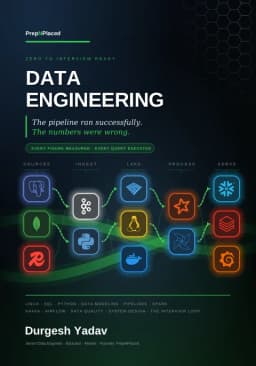
Data analyst, ETL developer, ETL tester and production support on data jobs are realistic first roles, because each puts you next to the pipelines and the SQL. There are also more analyst postings to apply for: in the India Tech Hiring Report, data-analyst postings numbered 2,467 (13.9% of 17,748), against 1,470 (8.3%) for data engineers. Volunteer for pipeline work, then apply for a junior or associate data engineer title once that work is on your resume. PrepNPlaced's Data Engineering Career Transition Playbook covers these routes, with 20 pages free to read after sign-in.

Realistic first roles, and what each one carries over to data engineering
First roleWhat you do thereWhat carries over to data engineering
Data analystSQL queries, Excel and dashboards for business teamsSQL depth, knowing the data, working with the people who use it
ETL developerBuild and maintain loads in tools such as Informatica, SSIS or Azure Data FactoryPipelines, scheduling, incremental loads and failure handling
ETL or data testerCheck that loads match the source and write SQL test casesData quality checks, reconciliation queries and edge cases
Production support on data jobsMonitor scheduled jobs, rerun failures and fix small issuesHow pipelines break, reading logs, on-call habits
MIS or reporting executiveDaily and monthly reports from Excel and databasesBusiness data, and automating reports with SQL and Python

FAQ

Common Questions

Is BCA enough, or should I do MCA first?

BCA is enough to start this plan. MCA adds two years and a postgraduate degree that some employers prefer, but the screening rounds test SQL, Python and projects either way. If you choose MCA, follow the plan during it, so you finish with projects and not only marks.

Can I become a data engineer after B.Sc?

Yes. A B.Sc in Computer Science or IT starts close to BCA: begin with SQL depth and Python for data. A B.Sc in Maths, Statistics or Physics starts with Python from the basics, and your statistics helps later with data quality work. The plan and the first roles are the same.

Can an MBA graduate become a data engineer?

Yes, usually through an analyst role first. Domain knowledge in finance, retail or operations makes you useful on an analytics team quickly, and SQL, Python and pipeline work lead on to data engineering. The technical rounds will test you as they test an engineering graduate.

Can I become a data engineer without a degree?

It is possible, but narrower. Aim at employers whose postings do not ask for a degree, put your projects and any work history at the top of your resume, and consider a distance or open-university degree in parallel.

Do I need a certification to get my first data job?

No. A certification helps once you have projects to back it. AWS recommends 2-3 years of data engineering experience and 1-2 years on AWS for its Data Engineer - Associate exam, so it is a later step. The Databricks Certified Data Engineer Associate lists no prerequisites.

Next Step

Turn The Guide Into Practice

Use PrepNPlaced tools to turn this learning path into resume proof, targeted practice, and interview-ready explanations.

Read the Data Engineer Roadmap