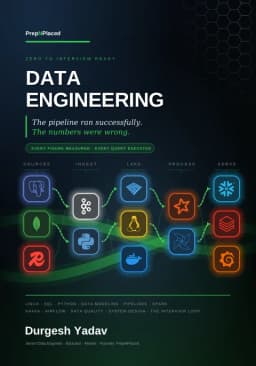
How to Become a Data Engineer in India (2026): Step-by-Step Roadmap
A step-numbered 8-12 month roadmap from zero to hired data engineer in India: exact skills in order, what to skip, fresher vs career-switcher paths, campus vs off-campus strategy, and how pay grows after the first job.
By Durgesh Yadav — Senior Data Engineer @ 7-Eleven · Updated 19 Oct 2026. Preparation guidance, not a hiring guarantee.
How do I become a data engineer in India?
To become a data engineer in India, learn SQL and Python (months 1-3), warehousing and data modeling (months 3-5), Spark plus one cloud platform (months 5-8), then Airflow and two end-to-end projects (months 8-10). Apply via Naukri, LinkedIn, and referrals from month 10. Disciplined learners are job-ready in 8-12 months.
Step 1: SQL and Python — The Non-Negotiable Base (Months 1-3)
SQL decides more data engineering interviews in India than any other skill — screening rounds at services companies, GCCs, and product firms all lead with it. Spend the first 6-8 weeks on joins, window functions, CTEs, aggregation edge cases, and reading query plans, then solve at least 100 problems on StrataScratch or LeetCode. In parallel, learn Python for data work: file handling, APIs, pandas, and error handling — not Django or full-stack development. By month 3 you should be able to write a script that pulls data from an API and loads it into PostgreSQL without a tutorial.
Skip web frameworks, heavy DSA grinding, and 'SQL in 24 hours' shortcuts
Milestone: an API-to-PostgreSQL loader script written from scratch
Step 2: Data Warehousing and Modeling (Months 3-5)
Warehousing knowledge separates data engineer candidates from generic Python programmers. Learn dimensional modeling — star schemas, fact and dimension tables, slowly changing dimensions — and the OLTP vs OLAP distinction interviewers reliably probe. Pick one cloud warehouse (BigQuery and Snowflake have free tiers) and rebuild a raw dataset into a clean star schema inside it. Add dbt basics here; it appears in a growing share of GCC and startup job descriptions in India.
Star schema, fact vs dimension tables, SCD Type 1 and Type 2
OLTP vs OLAP, columnar storage, partitioning and clustering
Hands-on: model a public dataset (e.g., e-commerce orders) in a warehouse free tier
dbt fundamentals: models, tests, documentation
Step 3: Spark and One Cloud — Not Three (Months 5-8)
Pick a single cloud and go deep: AWS and Azure dominate Indian data engineering postings, with GCP a viable third — learning all three before your first job wastes months. On the compute side, PySpark is the standard: DataFrame API, partitions, shuffles, joins on skewed data, and basic performance tuning. Databricks shows up heavily in GCC and product-company job descriptions, and its free Community Edition is enough to practice on. By month 8, you should be able to explain what happens inside a Spark job when it runs, not just call the API.
One cloud only: AWS (S3, Glue, Lambda, Redshift/Athena) or Azure (ADLS, Data Factory, Synapse, Databricks)
Practice on Databricks Community Edition — free and interview-relevant
Skip Hadoop/MapReduce internals; HDFS awareness is enough in 2026
Step 4: Orchestration, Streaming Awareness, and Two Real Projects (Months 8-10)
Orchestration turns scripts into pipelines — learn Airflow (DAGs, scheduling, retries, sensors) because it remains the most-asked orchestrator in Indian interviews. Add Kafka at awareness level: producers, consumers, topics, and where streaming fits — fresher roles rarely demand production Kafka experience. Then build two end-to-end projects that ingest real data, transform it with Spark or dbt, land it in a warehouse, and surface it in a dashboard, all scheduled by Airflow on your chosen cloud. Push both to GitHub with an architecture diagram and a README that explains your design decisions — this portfolio is what off-campus recruiters actually open.
Airflow: DAG design, scheduling, retries, backfills, idempotency
Kafka at concept level: topics, partitions, consumer groups, batch vs streaming trade-offs
Project pattern: API/files → Spark or dbt transform → warehouse → dashboard, scheduled end to end
GitHub: architecture diagram, decision-explaining README, clean commit history
Step 5: Applications — Campus, Off-Campus, and the Naukri Playbook (Months 10-12)
Campus hiring rarely offers 'data engineer' as a fresher title — mass recruiters like TCS, Infosys, Wipro, and Accenture hire generic engineers and allocate later, so take the offer and lobby for data projects from day one. Off-campus, work three channels in parallel: Naukri with a keyword-matched profile (recruiters search literal strings like 'PySpark' and 'Airflow'), LinkedIn for GCC and startup roles, and referrals, which convert far better than cold applications. Career switchers from testing, support, or BI should pivot internally first — a move to a data team inside your current company costs nothing and creates the 1-2 years of data-adjacent experience external recruiters want. Apply within 24-48 hours of a posting going live; Indian job posts drown in applicants within days.
Referrals first, cold applications second — the conversion gap is large
Career switchers: internal pivot to a data team, then external jump at 1-2 years
Expect 60-90 day notice periods at services companies; factor buyout talk into timing
How does salary progress, and what can you skip entirely?
Pay in India depends more on the type of company than on the title: services companies, GCCs and product companies pay on different scales for the same role. This page quotes no pay figures. PrepNPlaced's India Tech Hiring Report found that fewer than 300 of its postings disclosed an INR salary, too few to publish honestly. The standard trajectory is 1.5-3 years at a services firm or GCC, then a switch, and the services-to-product jump is where Indian data engineers usually make their biggest single gain. Treat certifications as tie-breakers, not entry tickets: skills and projects get interviews, certificates only decorate them. Skip deep machine learning, all-three-clouds coverage, and Hadoop internals. None of them shortens your path to a first data engineering job.
Company type sets the pay scale: services, GCC and product companies pay differently for the same title
Biggest jump: services → GCC/product switch at the 1.5-3 year mark
Skip: deep ML math, learning three clouds, Hadoop internals, certificate-collecting before projects
One certification maximum before job one, matched to your target cloud
Can a fresher become a data engineer directly in India?
Yes, but direct fresher data engineer openings are limited — GCCs and a few product companies hire them, while services companies hire generic engineers and allocate to data projects. Both routes work; the services route just adds 1-2 years before the title matches the work. Strong SQL plus two portfolio projects is what gets freshers shortlisted off-campus.
How long does it take to become a data engineer from zero?
Plan for 8-12 months at 2-3 focused hours a day if you are starting with no programming background. Working developers or BI and testing professionals who already know SQL can compress this to 4-6 months. The timeline that fails is the one that skips projects — tools without a portfolio rarely convert to interviews.
Do I need a B.Tech or computer science degree for data engineering?
There is no hard degree requirement in off-campus hiring — skills, projects, and SQL performance in interviews carry the decision. Some GCCs and large companies do filter on an engineering degree for fresher intakes, so non-CS graduates should target startups, services companies, and experience-based roles where filters loosen. Campus placement requires being on a campus; everyone else competes on the same portfolio.
Which cloud should I learn first for data engineering in India?
AWS or Azure — they dominate Indian data engineering job postings, and Azure is especially common in GCC and enterprise roles. Pick one, go deep on its data services, and ignore the others until you are employed. Cloud concepts transfer; recruiters need one confident answer, not three shallow ones.
Is DSA required for data engineering interviews?
Far less than for SDE roles. Most data engineering interviews in India weight SQL, data modeling, Spark, and pipeline design; product companies may add easy-to-medium DSA rounds. Two to three weeks of arrays, strings, and hashmap practice covers the typical bar — invest the rest of that time in SQL.
Can I switch to data engineering from testing or support?
Yes — it is the most common switcher path in India. Pivot internally first: volunteer for data-related work, automate reports with SQL and Python, and get a data team transfer on your record. After 1-2 years of data-adjacent experience plus portfolio projects, external recruiters treat you as experienced rather than a fresher restart.
Next Step
Turn The Guide Into Practice
Use PrepNPlaced tools to turn this learning path into resume proof, targeted practice, and interview-ready explanations.