New · Cohort 4AI-Powered Data Engineering Cohort 4 goes live 3 OctoberRegister now
Data Engineering Projects

Data Engineering Projects for Your Resume (2026): Four Builds With a Repo an Interviewer Can Open

A data engineering project counts when an interviewer can open the repo, run it, read what broke and see the number it produced. Four projects that meet that bar, from a free book chapter and a live cohort: a five-stage pipeline broken on purpose, a streaming lakehouse, a retail analytics warehouse and a Snowflake dbt build. What each proves, how to put it on a resume, and the questions it will draw.

By Durgesh Yadav — Senior Data Engineer @ 7-Eleven · Updated 27 Sept 2026. Preparation guidance, not a hiring guarantee.

Which data engineering projects should go on a resume?

Projects an interviewer can open and run: a public repo with a README that states the source, the pipeline stages, the checks and one measured result, plus a note on what broke and how you found it. One end-to-end batch pipeline with orchestration, one streaming or lakehouse build, and one warehouse with tested models cover the three shapes interviews ask about. Four such projects, with repos, are below; a certificate is not one of them.

Guide

What To Learn And How To Practice

What makes a data engineering project count in an interview?

Interviewers do not grade the stack; they grade whether the project ran, whether you know why the number is right, and what you did when it was wrong. A repo that scores on those three beats a certificate every time, because a certificate cannot be opened. Four things every project below has, and every project you build should: a README that says what goes in and what comes out; a way to run it from an empty folder; at least one check that would have caught a wrong result; and a measured figure, with the query that produced it.

A README with source, stages, checks and one number
Runs from a clean clone: setup steps, sample data, one command
A quality gate: row counts, a reconciliation, a freshness check
A section titled 'what broke' with the fix, because that is the interview question
Project 1: the five-stage pipeline from the free book, broken on purpose

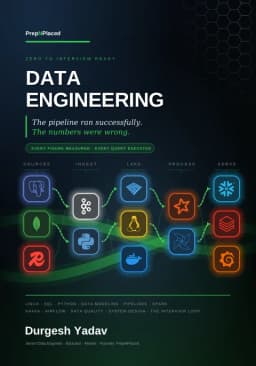
Chapter 13 of PrepNPlaced's free book builds one pipeline in five stages from an empty folder, over the ShopKart dataset the whole book uses, and then breaks it four ways on purpose: a join that fans out, a load that runs twice, late-arriving rows, a schema change. Every run's output is printed, including the wrong ones. The complete project, the mock API it reads from, the break tests and the Airflow DAG are in the Field Kit repository on GitHub, so you can reproduce it, then change it. This is the project to do first, because it teaches the shape the other three assume: ingest, validate, model, load, orchestrate, and check the number at the end against the source.

Stack: Python, SQL, Parquet, Airflow; a mock API as the source
What it proves: idempotent loads, watermarks, MERGE done properly, a quality gate that stops a bad table
The interview draw: 'your job ran fine yesterday and produced a wrong number today, what changed?' has a worked answer here
Where: the Field Kit repo linked from the book page, chapter 13 starts on page 200 of the 244

The four breaks, and the number each one moves

A join fan-out that overstates revenue by 44.9% with no error; a load run three times that triples revenue while every run reports success; a slowly-changing-dimension choice that moves ₹4,749 between two cities retroactively; and a CSV-to-Parquet change measured at 34.8 times smaller. Each is a chapter in the book and a test in the repo.

Project 2: StreamCommerce Lakehouse 360 (Kafka, Spark Structured Streaming, Delta Lake, Databricks)

A real-time e-commerce lakehouse: orders and clickstream stream through Kafka into a bronze, silver and gold medallion on Delta Lake, and a live revenue dashboard reads the gold layer. Built in the Data Engineering cohort in a three-hour project session and published to a public repo.

What it proves: event ingestion, exactly-once streaming, medallion modelling, and a dashboard you can defend
The interview draw: delivery semantics, checkpointing, why bronze keeps the raw event, and what happens to late events
Repo: github.com/analyticsdurgesh/StreamCommerce-Lakehouse-360

Project 3: Retail Revenue Intelligence (SQL, Python, pandas, Power BI)

End-to-end retail analytics: model the data, compute revenue, cohort and retention metrics in SQL and Python, and ship an executive dashboard. It is the warehouse-and-BI shape most Indian analytics and data roles interview on, and the one project of the four that a data analyst can also claim.

What it proves: SQL metrics, exploratory analysis, revenue and customer analysis, stakeholder-ready BI
The interview draw: define active customer before writing the query; explain why the cohort table's grain is customer-month
Repo: github.com/analyticsdurgesh/Retail-Revenue-Intelligence

Project 4: Snowflake and dbt analytics engineering (Snowflake, dbt, SQL, ELT)

A modern ELT warehouse: tested, documented dbt models and incremental pipelines into dimensional marts on Snowflake, with lineage. It is the project that answers the 'have you used dbt in anger' question that product companies and consultancies ask.

What it proves: dbt models, tests, docs and lineage; incremental loads; warehouse cost and performance trade-offs
The interview draw: incremental strategy, snapshot versus SCD type 2, what a dbt test catches that a schema does not
Repo: github.com/analyticsdurgesh/Snowflake_DBT_Project

How do you put a data engineering project on a resume, and what will it be asked?

One line per project, in the shape 'built X that does Y, measured Z': 'Built a five-stage orders pipeline (Python, Airflow, Parquet) with a row-count quality gate; caught a join fan-out that overstated revenue by 44.9% in testing.' The number is the part the interviewer underlines. Then expect three questions on any project you list: walk me through the data flow, what broke and how did you know, and what would change at ten times the volume. If you cannot answer the second, the project is not ready for the resume.

Resume line: what you built, the stack in brackets, one measured result
Link the repo; a recruiter who clicks is a recruiter who calls
Prepare the three questions: data flow, what broke, ten times the volume
One project you can explain for fifteen minutes beats four you can explain for two

FAQ

Common Questions

What are good data engineering projects for freshers?

Start with the book's Chapter 13 pipeline, because it is built from an empty folder in five stages with every run's output printed, and the Field Kit repo lets you run it before you change it. Then the Retail Revenue Intelligence shape (SQL plus Python plus a dashboard), which most fresher interviews can follow end to end. Streaming and dbt come third; they are what separate you at product companies.

Should data engineering projects use real data?

Real enough to break. The book's ShopKart dataset is synthetic but carries duplicates, late rows and a fan-out on purpose; public datasets such as NYC taxi rides or GitHub events work too. What matters is that the data has the problems production data has, and that your README says which ones your checks caught.

How many data engineering projects do I need on a resume?

Two or three that you can defend for fifteen minutes each. Interviewers open one and go deep; a list of six tutorials signals that none of them went deep. Cover the three shapes if you can: a batch pipeline with orchestration, a streaming or lakehouse build, and a tested warehouse.

Are certificates worth less than projects?

In the interview, yes. A certificate says you sat through material; a repo says you made something run and know why its number is right. Most hiring managers open the repo and never mention the certificate. Keep both, but lead with the project.

Where do the cohort projects come from?

The three named here are built live in PrepNPlaced's Data Engineering cohort in three-hour project sessions and published to public GitHub repos under the student's name, alongside the instructor's reference repos linked above. The book's Chapter 13 project is free and needs no cohort.

Next Step

Turn The Guide Into Practice

Use PrepNPlaced tools to turn this learning path into resume proof, targeted practice, and interview-ready explanations.

Get the free Data Engineering book