Basic to advanced · 2026 edition
Data Modelling: Zero to Hero
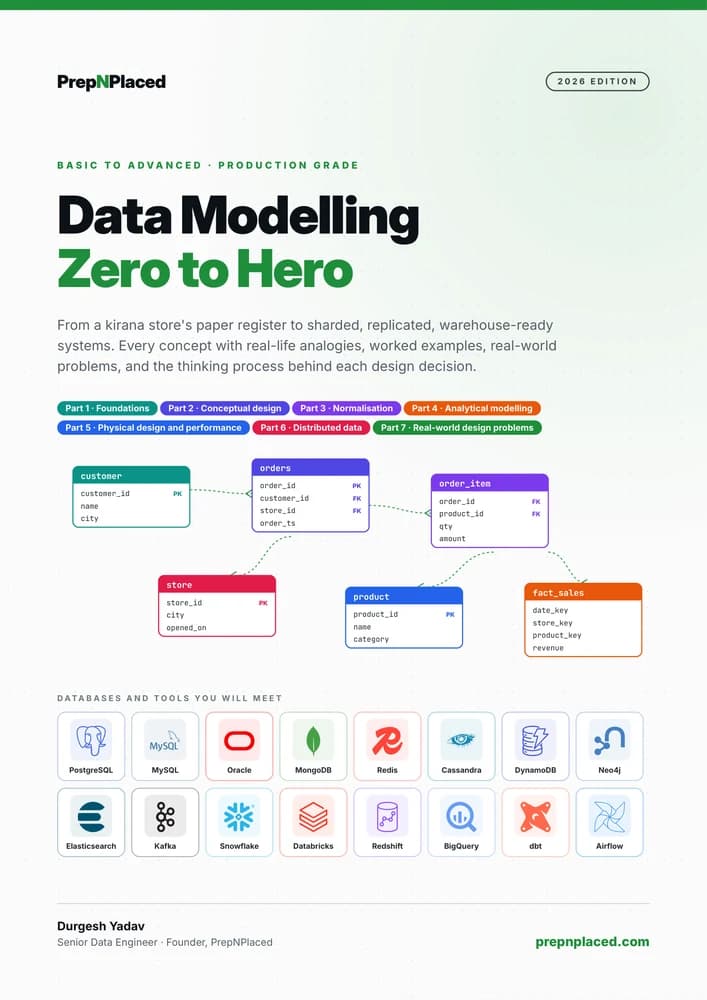
From a kirana store's paper register to sharded, replicated, warehouse-ready systems. Every concept with real-life analogies, worked examples, real-world problems, and the thinking process behind each design decision.
Data and the DBMS, transactions and ACID, inside a database system, ER modelling, normalisation from 1NF to BCNF, warehousing and dimensional modelling, dbt, Airflow and slowly changing dimensions, indexing, partitioning, sharding, query optimisation, CAP and replication. Then the design problems: a cab booking app, online banking, a Netflix-style streaming platform, an e-commerce MVP, an online course platform, a clinic, a capstone from OLTP to a warehouse and an interview playbook.
By Durgesh Yadav · Founder · Senior Data Engineer @ 7-Eleven · 2026 edition · 20 chapters · 93 pages
₹299
One payment. PDF, yours to download again any time.
Included free for learners in the AI-Powered Data Engineering cohort and in 1:1 mentorship: sign in with the email you enrolled with.
- chapters in seven parts, foundations to real-world design problems
- 20chapters in seven parts, foundations to real-world design problems
- pages in one PDF, to read here and to download
- 93pages in one PDF, to read here and to download
- pages free to read after one Google sign-in
- 20pages free to read after one Google sign-in
- case studies, a cab booking app to a clinic, then a capstone
- 6case studies, a cab booking app to a clinic, then a capstone
2026 edition · 20 chapters · 93 pages
All 20 chapters, in reading order
The book’s contents pages, in the book’s own seven parts. Each chapter starts on the page shown. Parts 1 to 3 teach you to design a correct database. Part 4 turns that data into analytics. Parts 5 and 6 make it fast and keep it running at scale. Part 7 puts it all together on real systems, the way an interview or a real project would ask you to.
Part 1Chapters 1 to 3
Foundations
- 01Data, Databases and the DBMSpages 4-7
- 02Transactions and ACIDpages 8-11
- 03Inside a Database Systempages 12-16
Part 2Chapters 4 and 5
Conceptual design
- 04ER Modelling: Entities, Attributes and Relationshipspages 17-22
- 05Advanced ER: Specialisation, Generalisation, Aggregationpages 23-27
Part 3Chapter 6
Normalisation
- 06Normalisation from 1NF to BCNFpages 28-33
Part 4Chapters 7 and 8
Analytical modelling
- 07Data Warehousing and Dimensional Modellingpages 34-40
- 08ETL/ELT, dbt, Airflow and Slowly Changing Dimensionspages 41-46
Part 5Chapters 9 and 10
Physical design and performance
- 09Indexing and Database Clusteringpages 47-51
- 10Partitioning, Sharding and Query Optimisationpages 52-56
Part 6Chapter 11
Distributed data
- 11CAP, Replication and Data Management Strategiespages 57-61
Part 7Chapters 12 to 20
Real-world design problems
- 12How to Think Like a Data Modellerpages 62-65
- 13Case Study: Scaling a Cab Booking Apppages 66-69
- 14Case Study: Online Banking Systempages 70-73
- 15Case Study: A Netflix-Style Streaming Platformpages 74-76
- 16Case Study: E-commerce MVPpages 77-80
- 17Case Study: An Online Course Platformpages 81-84
- 18Case Study: A Clinic Health Systempages 85-87
- 19Capstone: From OLTP to a Warehousepages 88-90
- 20Interview Playbook and Practice Problemspages 91-93
How it is written
Every chapter runs the same way
A book to read in order: each part builds on the one before, and one store’s data grows with you from a paper register to a warehouse. Open any chapter on its own before an interview, too: each one lists its sections first.
- 1In this chapterThe chapter opens with its numbered sections listed on its first page, so you see the ground it covers before you read.
- 2One running exampleEach idea is explained in plain words, often with a real-life analogy, then applied to DesiMart: one kirana store in Pune that grows to 200 stores, a delivery app and a warehouse full of reports.
- 3Real-world problemsBoxed scenarios show what goes wrong in a real system, how to solve it and the designer's thinking behind the choice, with the SQL and the tables written out.
- 4Interview questionsChapters 1 to 19 close with numbered interview questions and their answers. Chapter 20 is the playbook: rapid-fire revision, ten practice problems and a four-week plan.
Free sample
Read 20 of the 93 pages free
The cover, the two contents pages and the first page of 17 chapters:
- p1 Cover
- p2 Contents
- p3 Contents (continued)
- p4 Data, Databases and the DBMS
- p8 Transactions and ACID
- p12 Inside a Database System
- p17 ER Modelling: Entities, Attributes and Relationships
- p23 Advanced ER: Specialisation, Generalisation, Aggregation
- p28 Normalisation from 1NF to BCNF
- p34 Data Warehousing and Dimensional Modelling
- p41 ETL/ELT, dbt, Airflow and Slowly Changing Dimensions
- p47 Indexing and Database Clustering
- p52 Partitioning, Sharding and Query Optimisation
- p57 CAP, Replication and Data Management Strategies
- p62 How to Think Like a Data Modeller
- p70 Case Study: Online Banking System
- p74 Case Study: A Netflix-Style Streaming Platform
- p77 Case Study: E-commerce MVP
- p81 Case Study: An Online Course Platform
- p88 Capstone: From OLTP to a Warehouse
Checking your access to the book…
Who it is for
From your first table to your design round
- You are a student or fresher who wants data modelling taught from the start: what data is, then ER diagrams, then normal forms
- You build tables or pipelines at work and want the reasons behind star schemas, slowly changing dimensions, indexes and partitions
- You have a data modelling or design round coming and want to practise on real systems: cab booking, banking, streaming, e-commerce, a course platform and a clinic
- You want one running example that grows with the book, so each idea arrives at the stage where it starts to matter
- You want a taught course with live classes. See the Data Engineering cohort
- You want the whole data engineering stack, not one subject. See the Data Engineering End to End Notes
- You want round-by-round interview decks. See the Data Engineering Interview Kit
How to read it
- 1. Start from the contents. Pages 2 and 3 list all 20 chapters with their page numbers, in seven parts that build on each other.
- 2. Read the “In this chapter” list first.It names the chapter’s sections, so you know what it covers before the detail.
- 3. Close each chapter with its questions. Answer them out loud before you read the answers. Chapters 1 to 19 end this way.
- 4. Then design. Chapter 12 gives you a repeatable design process, chapters 13 to 19 use it on six case studies and a capstone, and chapter 20 is the revision: ten practice problems and a four-week plan.
Questions
Before you buy
Is this the Data Modelling module on the recordings shelf?
No. The module is the recorded class lectures and their notes, with a price of its own. This book is a separate 93-page PDF: 20 chapters in 7 parts, written to be read on its own.
What do I get?
The 93-page PDF, to read online here and to download, stamped with your email on every page.
Which pages are free?
The cover, the two contents pages and the first page of 17 chapters, after one Google sign-in. 20 pages in all.
Is it included in the Learn Pass or a plan?
No. Like the other PrepNPlaced books it is sold on its own. Data Engineering cohort learners, past and present, and mentorship members open it free from this page after signing in.
Does it help with interviews?
Yes. Chapters 1 to 19 close with interview questions and their answers. Chapter 20 is an interview playbook: rapid-fire revision across the whole book, ten practice designs with the tricky part called out, and a four-week plan.
Not for you? Start here
- You want the whole data engineering stack, not one subject. See the Data Engineering End to End Notes
- You want round-by-round interview decks. See the Data Engineering Interview Kit