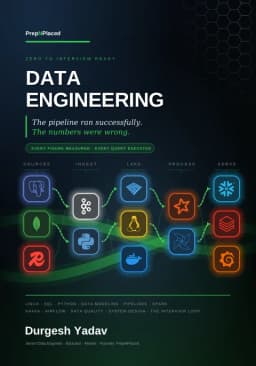
Data Engineering Roadmap 2026 (India): Month-by-Month Skills Plan
The current-year skills map for becoming a data engineer in India: what changed for 2026, a month-by-month plan, tools to learn vs skip, certifications that matter, and how pay grows.
By Durgesh Yadav — Senior Data Engineer @ 7-Eleven · Updated 19 Oct 2026. Preparation guidance, not a hiring guarantee.
What is the data engineering roadmap for 2026?
In 2026, learn SQL and Python first, then Spark, Airflow, dbt, and one cloud (AWS or Azure), followed by lakehouse formats like Delta or Iceberg and Kafka streaming. Add AI-assisted pipeline skills. Expect 8-12 months to job-ready.
Lakehouse is now the default architecture — 2026 job posts on Naukri increasingly name Delta Lake or Apache Iceberg directly. dbt has moved from nice-to-have to expected for transformation work. AI-assisted pipeline development changed interviews too: teams now test whether you can review and debug generated SQL and Spark code, not just write it from scratch. Streaming demand keeps rising as Indian fintech, quick-commerce, and GCCs push real-time use cases. Plan for 8-12 months to job-ready if starting from scratch.
Lakehouse (Delta Lake / Iceberg) is the default architecture in new 2026 job descriptions
dbt is now table stakes for modern data engineering and analytics-engineer roles
Interviews test AI-code review and debugging, not just syntax recall
Kafka/streaming appears in a growing share of GCC and product postings
Batch-only skill sets are getting filtered out at product companies
Step 1-3: Foundations (Months 1-3) — SQL, Python, One Cloud
Step 1 is SQL to an advanced level — window functions, CTEs, query tuning — because every Indian data engineering interview starts here. Step 2 is Python for data work: pandas, file handling, APIs, and writing clean functions. Step 3 is one cloud, not three; AWS or Azure covers most Indian postings, and Azure is especially common at services companies and GCCs. Spend 2-3 hours daily and build small working load scripts in this phase, not certificate collections.
Step 4 is Apache Spark via PySpark — still the single most-asked skill in Indian data engineering interviews. Step 5 is orchestration with Airflow plus transformation with dbt; in 2026 these two appear together in most modern job descriptions. Step 6 is lakehouse table formats: pick Delta Lake if you lean Databricks, Iceberg if you lean open-source or AWS. Build one end-to-end project — ingest, transform with dbt, orchestrate with Airflow, store as Delta or Iceberg — because that single project answers the majority of interview questions.
dbt models, tests, and docs on a warehouse (Snowflake trial or BigQuery sandbox)
One lakehouse format deeply (Delta or Iceberg), not both superficially
Step 7-8: Streaming and AI-Assisted Pipelines (Months 8-10)
Step 7 is Kafka fundamentals — topics, partitions, consumer groups — plus one streaming processor; Spark Structured Streaming is the pragmatic Indian choice. Step 8 is the 2026 differentiator: use AI assistants to scaffold pipelines while you own the review — data-quality checks, idempotency, and cost awareness. Interviewers increasingly ask how you validate generated code; have a real answer backed by examples from your project. This phase is what separates 2026 candidates from 2023-era course graduates.
Kafka basics plus Spark Structured Streaming on one real data feed
Data-quality gates: dbt tests or Great Expectations wired into your pipeline
Practise reviewing and fixing AI-generated SQL and PySpark — it comes up in interviews
Document cost decisions (cluster sizing, storage tiers) in your project README
Which tools should you learn vs skip in 2026?
Learn: SQL, Python, PySpark, Airflow, dbt, Kafka, one cloud, Delta or Iceberg, Docker basics, and Git. Skip for now: Hadoop MapReduce and Hive (legacy maintenance only), Scala-first learning (Python covers Indian interviews), and stacking certifications. Deprioritise multi-cloud breadth — recruiters on Naukri filter by depth in one stack, not shallow coverage of three. If your target is services companies, add Azure Data Factory and Synapse/Fabric; if product companies, deepen Spark internals and pipeline system design.
Services target: Azure Data Factory, Synapse/Fabric pipelines
Product target: Spark internals, data modelling, system design rounds
Which certifications matter, and how does pay grow?
Certifications that carry weight in Indian resume screening: Databricks Data Engineer Associate, AWS Data Engineer Associate, and Azure DP-700. One is enough; projects matter more. On pay, company type matters more than the title: services companies, GCCs and product companies pay on different scales. This page quotes no pay figures. PrepNPlaced's India Tech Hiring Report found that fewer than 300 of its postings disclosed an INR salary, too few to publish honestly. Off-campus, the standard funnel is Naukri plus LinkedIn plus referrals; refresh your Naukri profile weekly because recruiter search ranks on activity and keywords. The common Indian path is 2-3 years at a services company or GCC, then a switch to product, so plan around the 90-day notice period most services firms enforce.
One cert max: Databricks DE Associate, AWS DE Associate, or Azure DP-700
Pay scale follows company type: services, GCC and product companies pay differently for the same title
Update Naukri weekly — recruiters filter by last-active date and JD keywords
Service→product switch typically lands after 2-3 years; interview in parallel with your 90-day notice
Is data engineering still worth it in 2026 with AI writing code?
Yes. AI accelerates pipeline writing but shifts the job toward design, code review, data quality, and cost control — skills interviews now test directly. Demand from Indian GCCs and product companies remains strong; the roles under pressure are pure-scripting ones, which is why this roadmap emphasises architecture, streaming, and reviewing generated code.
How long does it take to become job-ready as a data engineer?
8-12 months from scratch at 2-3 hours of daily study. Working IT professionals with existing SQL exposure (support, testing, admin backgrounds) can compress this to 6-8 months. The end-to-end project phase in months 4-7 is the one part you cannot skip.
Which cloud should I pick for data engineering in India?
Pick one, not three. Azure if you are targeting services companies and GCCs, where it dominates postings; AWS if you are targeting startups and product companies. GCP is a valid third option but has fewer Indian data engineering postings, and depth in one cloud beats shallow coverage of all of them.
Are data engineering certifications worth it in 2026?
One is worth it for resume screening at services companies and GCCs; a second adds almost nothing. Databricks Data Engineer Associate currently signals the most in lakehouse-era hiring, with AWS Data Engineer Associate and Azure DP-700 close behind. No certification substitutes for a deployed end-to-end project.
Do I need DSA for data engineering interviews?
Product companies ask light-to-moderate DSA (arrays, strings, hashmaps) alongside SQL and Spark rounds; services companies and GCCs mostly skip heavy DSA. Prioritise SQL and pipeline design first, then do 50-70 easy/medium problems only if you are targeting product firms.
What salary can a fresher data engineer expect in India?
PrepNPlaced quotes no figure: its India Tech Hiring Report found that fewer than 300 of its postings disclosed an INR salary, too few to publish honestly. Company type sets the scale, since services companies, GCCs and product companies pay differently for the same fresher title, and city, hiring channel (campus vs off-campus) and interview performance decide where you land. Check current figures in salary-disclosed postings and on salary sites that show a sample size.
Next Step
Turn The Guide Into Practice
Use PrepNPlaced tools to turn this learning path into resume proof, targeted practice, and interview-ready explanations.