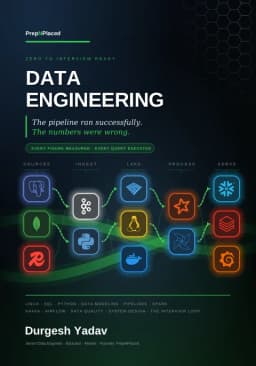
Is Data Engineering a Good Career in India? An Honest 2026 Assessment
An honest, evidence-framed answer to whether data engineering is worth choosing in India: demand drivers, salary trajectory, comparisons with SDE, DA, and DS, who should avoid it, and the 5-year outlook.
By Durgesh Yadav — Senior Data Engineer @ 7-Eleven · Updated 19 Oct 2026. Preparation guidance, not a hiring guarantee.
Is data engineering a good career in India?
Yes, data engineering is one of India's strongest tech careers in 2026. GCC expansion and AI data-pipeline demand keep hiring strong, and supply of skilled engineers still trails demand. Choose it if you enjoy SQL, systems, and infrastructure more than modeling or pure app development.
Data engineering is the work of building and running the systems that move data from where it is created, such as apps, payments and logs, into clean, reliable tables that analysts, dashboards and machine learning models use. In simple words: data engineers build the pipes, and everyone else uses what comes out of them.
Example: an order placed in a shopping app lands in a database; a nightly pipeline copies it to a warehouse, removes duplicates and joins it to customers and products, and the sales dashboard reads the result
The work day to day: SQL and Python transformations, pipelines scheduled in Airflow, Spark for data too big for one machine, warehouse tables to model, and a failed run to fix
Why it matters for jobs: data engineer was 1,470 of 17,748 live Indian tech postings (8.3%) in PrepNPlaced's India Tech Hiring Report, 23 August to 27 September 2026, up from 4.3% in July
What is the difference between data engineering and data science?
Data engineering builds the pipelines and tables that hold trustworthy data; data science uses that data to build models and run experiments that predict or explain. Engineers are judged on whether the data arrives correct and on time, scientists on whether their models and conclusions hold up. In India, data engineering has more openings per applicant.
Data engineering builds the data; data science models it
Dimension
Data engineering
Data science
Question it answers
Is the data correct, complete and on time?
What will happen, and why?
Main work
Pipelines, warehouses, data quality checks
Statistics, experiments, machine learning models
Core skills
SQL, Python, Spark, Airflow, one cloud, data modelling
Not quoted: PrepNPlaced has no sourced figure for data engineers
About 6-14 LPA (upGrad's figure, as compiled in PrepNPlaced's India Tech Salary Report 2026 post)
Suits people who enjoy
Systems, SQL and reliability problems
Research, statistics and modelling
What is the short verdict on data engineering?
Data engineering in 2026 is one of the best risk-adjusted careers in Indian tech: demand is broad, fresher competition is thinner than data science, and the salary ceiling matches software engineering at product companies. The trade-off is the nature of the work — you build and repair the plumbing others rely on, which means production incidents, data-quality firefighting, and less visible glory than shipping user-facing features. If SQL, systems, and reliability problems energize you, the career compounds well; if you need your work seen by end users, it will frustrate you. The sections below give you the evidence to decide.
Strong demand across services firms, GCCs, startups, and product companies in India
Less crowded entry than data science; pay parity with SDE at product level
Real downside: on-call pipelines, invisible work, constant tooling churn
Best fit: people who enjoy systems and infrastructure over interfaces
What is driving demand for data engineers in India?
Two forces keep Indian data engineering hiring resilient even in slow years. First, global capability centres (India hosts over 1,700 of them) have moved from cost centres to engineering hubs, and most run data platform, analytics engineering, and pipeline teams. Second, every AI initiative is a data initiative underneath: LLM applications, RAG systems, and ML products all fail without reliable pipelines, which expands demand for engineers who can deliver clean, governed, well-modeled data. In PrepNPlaced's India Tech Hiring Report, data engineering doubled its share of Indian tech postings between July and September 2026, from 4.3% to 8.3%, the largest move of any role family.
GCC expansion: 1,700+ centres, most running dedicated data platform teams
AI and LLM products need pipelines, quality checks, and governed data underneath
Data engineering's share of Indian tech postings went from 4.3% in July to 8.3% in September 2026 (India Tech Hiring Report)
Demand spans banking, retail, healthcare, and SaaS — not one sector's boom
How do data engineer salaries progress?
PrepNPlaced quotes no data engineer pay figures: its India Tech Hiring Report found that fewer than 300 of its postings disclosed an INR salary, too few to publish honestly. Services companies, GCCs and product companies pay on different scales for the same title, and the trajectory matters more than the starting point: the services-to-GCC or services-to-product switch at 1.5-3 years of experience is usually the biggest single raise. By year five, engineers who kept upskilling in cloud depth, Spark tuning, and platform work are the ones GCCs and product firms compete for. The ceiling extends into architect and staff roles where compensation competes with any software track in India.
No PrepNPlaced pay figures: check current ones in salary-disclosed postings and on salary sites that show a sample size
The 1.5-3 year company switch is the single biggest compensation lever
By year five, cloud depth, Spark tuning and platform work decide which GCC and product offers you get
Notice periods (60-90 days at services firms) are the tax on every switch
How does data engineering compare with SDE, data analyst and data scientist roles?
Against SDE: pay reaches parity at product companies and interviews demand less DSA grinding, but SDE offers broader role variety and more visible output. Against data analyst: DA is easier to enter and lighter on engineering, but its salary ceiling is lower and progression often bends back toward engineering anyway. Against data scientist: DS fresher hiring in India is intensely crowded with a high credential bar, while DE has more openings per applicant and a faster route to strong pay — many DS aspirants end up doing pipeline work regardless. Choose by the work itself: DE builds systems, DA answers questions, DS models uncertainty, SDE builds products.
vs SDE: pay parity at product level, lighter DSA bar, narrower but deeper scope
vs Data Analyst: higher ceiling and a stronger engineering moat, harder entry
vs Data Scientist: far better openings-to-applicant ratio for freshers in India
Common pivot: DA → DE at 1-2 years is a well-trodden Indian career path
How long does it take to learn data engineering?
It depends on where you start and how many hours you put in each week, so measure progress in skills you can show, not in months. Someone who already writes SQL at work moves faster than a fresher starting from zero. PrepNPlaced's step-by-step plan on the How to Become a Data Engineer in India page is built around 8 to 12 months of steady part-time study, in this order:
1SQL until you can write joins, window functions and CTEs without looking anything up.
2Python for data: files, functions, pandas, and calling an API.
3One warehouse and data modelling: fact and dimension tables, and slowly changing dimensions.
4Spark with PySpark on data bigger than your laptop's memory, then partitioning and joins.
5One cloud and one orchestrator, usually Airflow, running a pipeline on a schedule.
6Two end-to-end projects on GitHub, then interview practice on real questions.
Who should not choose data engineering?
Skip data engineering if you need your work visible to end users — pipelines succeed silently and fail loudly, and recognition follows the same pattern. Skip it if debugging drains you: a meaningful share of the job is diagnosing why a pipeline failed overnight or why yesterday's numbers changed. Skip it if your real goal is machine learning research or model building — DE is adjacent to DS, not a backdoor into it, and switching later costs real effort. And skip it if you want a learn-once toolset: Spark, cloud services, orchestrators, and table formats churn fast enough that a static skill set depreciates within 2-3 years.
You want user-visible, demo-able output — choose SDE or frontend instead
Debugging and on-call incidents drain rather than engage you
Your actual goal is ML modeling or research — target DS directly
You want a stable toolset — DE's stack churns every 2-3 years
What is the 5-year outlook (2026-2031)?
AI raises the value of data engineering rather than replacing it: generated code writes boilerplate ETL faster, but deciding what to build, guaranteeing data quality, and running platforms reliably remain human work — and every new AI system adds pipelines to maintain. The role is drifting toward platform engineering, data quality ownership, and AI-adjacent work like feature and retrieval pipelines, which pushes salaries up for engineers who move with it. The genuine risk sits at the low end: profiles limited to drag-and-drop ETL tools with no SQL, cloud, or design depth are the ones automation squeezes. Expect strong demand through 2031, with a widening gap between commodity-tool operators and engineers who own systems.
AI multiplies pipelines to build and maintain; it does not remove the builder
Role drift: toward data platforms, quality ownership, and RAG/feature pipelines
At-risk profile: ETL-tool-only skills with no SQL, cloud, or modeling depth
Safe bet: system ownership plus cloud depth keeps compounding through 2031
Is data engineering better than data science in India?
For getting hired, usually yes: DE has more openings per applicant, a lower credential bar, and comparable pay at product companies. Data science offers modeling work DE does not, but fresher DS hiring in India is intensely competitive. If your goal is a strong tech career rather than specifically building models, DE is the higher-probability path.
Will AI replace data engineers?
AI is automating boilerplate ETL code, not the job. Deciding architecture, guaranteeing data quality, and operating platforms reliably still require engineers — and every AI system deployed adds new pipelines to build and maintain. The at-risk profile is the ETL-tool-only operator without SQL, cloud, or design depth.
Is data engineering a stressful job?
It has a specific stress shape: production pipeline failures, on-call rotations at some companies, and pressure when business dashboards break. It typically has less deadline crunch than client-facing services projects and less publish-or-perish pressure than research-flavoured DS roles. Companies with mature platform teams are noticeably calmer than lean startups running fragile pipelines.
What salary can a data engineer expect after 5 years in India?
PrepNPlaced quotes no figure: its India Tech Hiring Report found that fewer than 300 of its postings disclosed an INR salary, too few to publish honestly. Where you have worked and what you can show decide it. Engineers who kept upskilling and moved to a GCC or product company usually earn more than those who stayed at one services company without switching, which is why the 1.5-3 year switch matters so much. Check current figures in salary-disclosed postings and on salary sites that show a sample size.
Can a non-CS graduate build a data engineering career?
Yes — off-campus hiring runs on demonstrated SQL, Python, cloud skills, and projects rather than degree filters. Some GCC and large-company fresher intakes do require an engineering degree, so non-CS graduates should enter via startups, services firms, or analyst roles and pivot within 1-2 years. The path is longer, not closed.
Is data engineering in demand in India in 2026?
Yes. GCC expansion and AI data needs keep postings broad on Naukri and LinkedIn across banking, retail, SaaS, and healthcare. In PrepNPlaced's India Tech Hiring Report, data engineering doubled its share of Indian tech postings between July and September 2026, from 4.3% to 8.3%, the largest move of any role family. Supply of engineers with real Spark, cloud, and modeling depth still trails demand.
Why is data engineering important?
Because every dashboard, report and AI model is only as good as the data under it, and data engineers are the people who make that data arrive correct and on time. Every AI system a company ships adds pipelines to build and maintain. The postings show it: data engineer roles rose from 4.3% to 8.3% of Indian tech postings between the July and September 2026 editions of PrepNPlaced's India Tech Hiring Report.
Is a data engineer job difficult for a fresher?
The first months are hard because the job mixes SQL, Python, cloud tools and other teams' data at once. What makes it manageable is the same for everyone: strong SQL, small steps you can test, and a habit of checking row counts before you trust a number. Freshers who have built one pipeline end to end, even a small one, settle in much faster.
Why is data engineering hard?
Because the work is distributed systems plus other people's data. Pipelines fail overnight, sources change without warning, and a wrong number looks exactly like a right one until someone checks it. The tools keep changing, so the learning does not stop. Strong SQL, small tested steps and checks that fail loudly are what make it manageable.
Next Step
Turn The Guide Into Practice
Use PrepNPlaced tools to turn this learning path into resume proof, targeted practice, and interview-ready explanations.